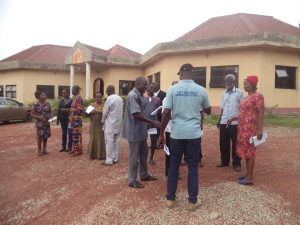
As a grassroot oriented organization, HRCRC has spread across the 13 local government areas of the state over 25 branches. Today a team from HRCRC headquarters visited her newly formed and inaugurated branch at Onuayim Isieke branch to encourage her members.
In this fight to curb injustice and entrench human rights, whilst encouraging peaceful coexistence through conflict resolution strategies, there are numerous sacrifices and hazard. However, we are excited and convinced that this walk is for the utmost good of humanity, and we shall walk the walk.
We are grateful to our Onuayim branch for their doggedness towards this cause.
in furtherance of our efforts in promoting peace, the Rule of law and Justice, HRCRC and personnel of the newly opened state office of the National Human Rights Commission NHRC, and a CSO – Youths for Human Rights, visited Radio Nigeria management to further consolidate the existing relationship between the bodies to help propagate the tenets of peace in the very fragile society we now live in.
Also, we visited The Commissioner of Police, Abakaliki Command and the Comptroller of Prisons, Abakaliki to deliberate on ways and strategies to help reduce the rising spate of human rights abuses both in the prisons and in the society.
Representing HRCRC was George Etamesor – Acting Director, Gana Stephens and Moses Ekeke, and Chris Okorie – State Coordinator National Human Rights Commission Abakaliki and staff and the team of Youths for Human Rights, Abakaliki.
Still on ensuring Peaceful and Violence Free Elections in Ebonyi State, and against the backdrop of the role and clout of women in our society, HRCRC organised a workshop for Women Leaders across the State on the visible and realistic dangers of electoral violence, and how they can be advocates for peace in all facets of the society they dwell.
Once upon a time we would rush out at the sound of human click sounds – imitating the very fascinating Zulu ‘X’ sound – and the accompanying moo. It was interesting to watch how little petite very handsome curly haired Fulani boys controlled these gigantic white sluggish mammals with horns; Ah Yes, the horns! That they valued the life of the animals under their charge didn’t really stir up debates. Instead we were impressed with their smooth carved crosiers; along with the little daggers they wore around their waists like Navy Seals in full combat gear. Also, very inspiring was idea that these little dark handsome curly-haired bundles of calm confronted wild beasts in the wild regularly with their daggers to protect their mammalian wards.
I suppose the wild beasts in the wild grew more ferocious for soon, during the harmattan when the human click sounds accompanied by the moo passed by, in the stead of daggers we saw machetes not on their waists but held on their hands seemingly nonchalantly but at a ready. Then we heard on the news that they now carried riffles to protect themselves and their charge from the ever-evolving dangers of the wild. Logically following this projection, soon they may need RPGs and grenades and the likes and, in a few years, when the issue of Nigeria comes up at the UN General Assembly, President Trump and Kim of North Korea will have to shut up because their quarrel will be petite in comparison.
Collectively, from the developing world of Europe and North America to the underdeveloped of South America, some of the far and middle east and indeed Africa, we have all managed to make a pleasant mockery of the Universal Declaration of Human Rights. All other inalienable right every human is entitled to just by being alive is pinged on the right to life. To pull off the hinge is to render quite redundant the door functionality of a door. If only humans beings who are alive are referred to as humans – dead ones are referred to as bodies or corpse -, and If every other right of a human is only valid because that human is alive, It therefore logically follows that by the wanton disregard and disrespect for the dignity of human life, so passionately and fantastically exhibited throughout the world today, we all have passively and actively destroyed the hinge on which all other rights revolve.
Ironically, while this rubbishing of all Human Rights in other climes have some sort of not justifiable in any sense but at least dignified push behind it, Nigeria chose to align herself with the less dignified kind of genocidal tendency; – the ones that have an undertone reference to animals. Nigeria is proudly in the company of the likes of the Rwandan genocide – with their Cockroaches reference; but since we are the giant of Africa, why not choose a more gigantic animal – say Cows? Just why not? As if that is not enough disgrace, families and boarder communities continue to deprive people of their right to life in Ebonyi state over land disputes and sundry matters, the Izzis and Ukelles are killing themselves over something that happened before they were born; then kidnappers, cultists, ritualists, careless officers of the law, robbers – both armed and not, mob action/jungle justice and herdsmen graciously join in compounding the situation for us.
It was remarkable to read a leader make subtle comparison between the life of cattle and the life of a human being. The Miyetti Allah Cattle Breeders’ Association of Nigeria was alleged to have elusively said that the murder of more than a hundred innocent persons in Plateau State was a reprisal attack for cattle rustling in the town and even threatened – sorry, cautioned that there would be no peace in the area because of this great crime against humanity – cattle rustling. Instinctually, my first reaction was with great deference to his fundamental human right to speech and opinion, how dare he make a subtle defence of the inhumane murder of human beings right in their houses and compare it to the killing and rustling of cows, and even daring to justify his stance by saying there will be no peace. And I am sure many other southern Nigerians shared similar or even less agreeable sentiments. Eventually, this news was found to be inaccurate. The sudden proliferation of hate speeches and fake news mostly born out of stereotypes and prejudices is both unhealthy and a catalyst for disintegration and possibly annihilation. But this is an issue for another day. Today’s issue is that just like clockwork, Nigeria reacted. And this is what I have a problem with.
Whilst we moan, whimper, sniff and scream about the evolving tactics of protection employed by these curly haired shepherds, why is the government and security agencies tasked with the simple duty of protecting and securing lives of Nigerian Humans, not livestock, not learning from their positive cum negative – depending on your perspective – flux of protection? Or is that asking for too much from agencies whose sole task is securing our lives? Why can’t we learn to value human life like they value cow life? The curly-haired handsome fellows are being proactive while the rest of us – citizens, security agencies and indeed the political class/elected government are impressively reactive.
Soon after the news of the mass killing broke, the federal government as usual condemned the attack and as usual promised to bring the perpetrators to justice, and as usual promised to prevent a recurrence, members of the ruling and political class issued statements condemning the attack, the Nigerian Air Force deployed a Mi-35P combat helicopter and an Intelligence Surveillance and Reconnaissance (ISR) aircraft to Plateau State, the Commissioner of Police was replaced, and of course social activists protested and were as usual harassed by security agents. The impressive list of reactions goes on and on and on and all combined does absolutely nothing to comfort the grieving in Plateau State, resurrect those potentials cut short who just happened to be on the wrong end of a bullet or a machete, or even from experience prevent a recurrence. In fact, a week after the initial attacks, and all the reactions and follow-up politicising of the event, it was reported that another attack, with the same MO, in the same State, and by the same suspected handsome curly-haired fellows killed Human Rights again. And in a swift reaction, the Chief Executive of the Plateau State adjusted the already imposed curfew from 10pm – 6am to 6pm – 6am.
Human Rights are not passive, they are active. They are neither good nor bad, they just are. They are beyond the scope of morals or ethics or religion or I dare say even human judgement. Since their conferment is not reactive or a result of any human effort or dependent on any human factor, it is safe to aver that the drive to safeguard them be commensurate. Like the developing world, think-tanks and intelligence agencies should come up with -if they do not have already- operational preventive plans and measures for all foreseeable conflicts and attacks that are proactive; and if they cannot, they should bloody well say so, so that we can task persons both within and without our social entity to do so.
We cannot continue to wait for attacks to claim innocent lives and then go on a show of force to quell reprisal attacks or prevent the emotionally wounded to express their natural emotional frustration and revenge tendency. The hurt will result in a vicious circle of attacks and counter attacks that can breed hate and, well it just goes downhill from there. While the hypocrisy of persons, especially Christians rejoicing over reprisal attacks is glaring, it is also emotionally understandable but out rightly condemned. The murder of Zayyan Gwandu, son of the Commissioner of SARS – Haliru Gwandu Abubakar for example is not only crazy but also senseless and irrational; and would remain this way until someone convinces me that he was among the group of first attackers. And even after then, it would be illegal to deprive him of his right to life haphazardly without due recourse to legal procedure. One can understand the lack of faith in the security and legal system in Nigeria as one of the major reasons why mob action and unjust jungle justice is prevalent.
Also, professional conflict resolution experts should be employed to help intervene in these cases and their recommendations be implemented.
Kabiru works as a security officer in the house of Dr Alabi. Although, he was hired as a ‘gateman’, there is hardly any other chores Kabiru does not do in Dr Alabi’s compound. He washes the cars (Alabi has two, Lexus Jeep and a Toyota 4Runer), does gardening and man the security post. Since he took up the job about 3 years ago, he has not had time to go anywhere. Some time last year, he indicated interest to travel home for the Salah break, but Alabi would not have it, arguing that he did not hire him to be away from his duty post. Kabiru has since shelved the idea of traveling.
What worries Kabiru about his job the most however, is not even the manner in which his movement is restricted. It is rather that his condition of work has been poor and unappealing. The security room where he is supposed to live and operates from has barely anything for comfort. The room has an old stool Kabiru had patched more than five times since he resumed work, and a matt he uses to pray and also sleep upon. The room’s window is like a pigeon hole so that staying inside is pretty much like being carried in a black Maria van.
To make matters worse, Dr Alabi has not been forthcoming with Kabiru’s N10,000 monthly pay as at when due. For about 7 months now, he has been fed one story or another as to why he should exercise patience. While Kabiru waits in patience however, Dr Alabi never misses to entertain ‘business friends’, family members and ‘associates’ to sumptuous parties and dinners at almost every turn of the weekend. It is during this type of occasion that Kabiru gets to ‘feel his Oga’. He would be served food enough to keep his mouth munching for days. And when latter he gets to request for his meagre salary, he would be told:
“Ah, Kabiru! Don’t act like we treat you bad in this house? We give you food here. Wait, in this era of economic recession, who doesn’t owe salary in this country? Abeg, wait till next week please.”
_____________________________________________
Kabiru’s fate is similar to many people in our society today. Ours is a society that cuts and separate what are individuals’ due, and then give them in piecemeal while framing it to look as if, they are actually doing the individuals really some good that deserve commendation. For instance, during the peak of late payment of salary in Nigeria, the one blamed on the recent economic recession, few governments who were managing to keep up to date were busy broadcasting on air how good and praiseworthy their principals were. They do not owe salaries. But after a check on these governments, it was discovered that these same governments owe huge backlog of emoluments due to their workers outside the statutory monthly take home, including refusal to honour promotion awarded to workers. Till date, some states are still paying piecemeal salaries, with some workers receiving almost 25% of their monthly pay.
Away from salary, dignity of labour requires that a person’s condition of work should be dignifying. This principle takes into cognisance, things like number of hours spent on work, hours given for rest and leisure, and the condition of work space, whether such supports the worker to deliver more efficiently. It also involves whether a worker has access to health package that allow him/her to enjoy good health benefits. Opportunity for workers to development their capacity, and for what is called “vertical mobility of labour” (i.e. room for promotion) also count in favour of dignifying work condition. These issues are well covered in international instruments like International Covenant on Economic, Social and Cultural Rights, (see Article 7, a through d). Section (d) of Article 7 particularly addresses the need for leisure, “periodic holidays with pay, as well as remuneration for public holidays”.
Although, Nigeria is a signatory to the above Covenant, both public and private employers of labour continue to selectively honour some while violating many of these rights. their argument is akin to Dr Alabi’s family. They can afford to owe workers, but not the other way around. At least, they fulfil ‘some obligations’. Unfortunately, one of the fundamental principles undergirding respect for human rights is indivisibility. Human rights are a wholesome set of fair packages which should not be selectively respected.
Why is this the case? Well, no right is more important than the other, and each right is intricately linked to the rest of others. Take for instance, the picture painted above about Kabiru and his job. You cannot begin to discuss whether his pay is more important than the condition of his work. In each category, the condition of where he works, the amount of rest he gets, and of course, his take home package, all of these things invariably affect his human dignity by adding something to it (when they are fairly supplied) or subtracting something from it (when they are not met).
Are rights interdependent then? Absolutely, yes. The health of a worker obviously affects his/her productivity and job satisfaction. Equally, capacity building can positively impact on the dignity of labour. Hence, neglecting these elements, as many employers are doing in our society, grossly negate best practice and of course, violates human rights principles.
Beyond labour, this discussion can be applied to other sectors of the society. For instance, you don’t choose to feed your children while refusing them access to education when you can afford, or you don’t praise yourself for giving food money to your wife everyday while at every slight provocation, turn her into a punching bag, or you don’t choose to seek citizens’ votes while refusing them participation in issues of governance. Human rights are indivisible and are interdependent.
Shalom!
Contributors: C. O. Ikegbunam Esq.
C. A. Nwankwo Esq.
D. A. Okoliko
Disclaimer:
This is a free educational material and not a source of legal advice. If you need any, please consult your lawyer.
HRCRC Staff having outdoor activity during their 2017 Staff Day