2025 Human Rights Day Press Conference
INTERNATIONAL HUMAN RIGHTS DAY
HUMAN RIGHTS AND CONFLICT RESOLUTION CENTRE ABAKALIKI HRCRC
10th December, 2025
Ladies and Gentlemen of the Press, Distinguished guests, fellow advocates for Human Rights and Justice, and all who champion the cause of humanity, Good morning. It is with profound honor and a deep sense of responsibility that I stand before you today, on this auspicious occasion of Human Rights Day 2025. As the Director of the Human Rights and Conflicts Resolution Centre, Abakaliki, on behalf of our Board, and the Ebonyi State Civil Society Network, I welcome you to this press conference, where we gather not just to reflect, but to act. Today, December 10th, marks the 77th anniversary of the Universal Declaration of Human Rights, a beacon that reminds us of our shared dignity and equality. This year’s theme, “Human Rights: Our Everyday Essentials,” could not be more fitting. It emphasizes that human rights are not abstract ideas and ideals confined to words and speeches; they are the very essentials of our daily lives—the air we breathe, the security we seek, and the opportunities we pursue, the respect we crave and the dignity we deserve. They are positive forces that bring joy, safety, progress and transcendental fulfilment to individuals and communities alike.
Across Nigeria and here at home in Ebonyi State, this theme resonates deeply amid the daily challenges we face. Human rights are essential because they protect us from exploitation, ensure access to basic needs, and enthrone the rule of law and justice, fostering peaceful resolutions to conflicts. Yet, in our everyday realities, these rights are often undermined by systemic issues that affect the most vulnerable among us, especially.
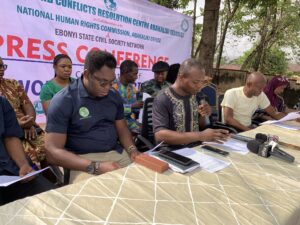
Today, we will address some of these pressing concerns as we remain committed to advocating for justice, mediating conflicts, providing access to mental health care, and empowering citizens to claim their rights.
1. Terrible state of the access road to the Human Rights and Conflict Resolution Centre (HRCRC): I will start by acknowledging the difficulty you experienced in getting to our office today due to the state of the access road – Rev Fr Kevin O’Hara Close, off Hill Top Road near the Water Reservoir in Abakaliki. There have been several documented promises by the State Government to fix the road, but none have come to fruition. As such, residents around here and vulnerable persons trying to access our office are sometimes injured by accidents occasioned by the road, or put through hardship to access help. This not only violates the right to access justice and essential services but also discourages vulnerable individuals—such as victims of abuse or those seeking mediation—from reaching us safely and promptly. In a theme emphasizing everyday essentials, a functional road to a human rights and peace hub is fundamental. We call on the Ebonyi State Government to prioritize immediate repairs, paving, and drainage improvements to ensure unobstructed access for all.
2. Extortion by the Enugu Electricity Distribution Company (EEDC): Reports from Eboyians and residents on the illegal and exploitative activities of EEDC and its agents grew exponentially this year. For far too long, residents of Ebonyi State have endured arbitrary billing, disconnections without due process, and coercive demands that border on extortion. This not only violates the right to fair treatment and access to essential services but also erodes the everyday essentials of human dignity and economic stability, all because of practices that prioritize profit over people. On this Human Rights Day, while we acknowledge their efforts to address individual cases brought to their attention, we are particularly concerned about those who are unable to access help and so suffer in silence. Therefore, we call on EEDC to reform and improve its organizational and systemic operations, implement transparent billing systems for unmetered and postpaid customers, and engage in community dialogues to rebuild trust. Moreover, we urge regulatory bodies like the Nigerian Electricity Regulatory Commission to enforce stricter oversight and penalties for violations as they seem to act too slow or fail in their mandate.
State-owned power generation utilizing our rivers, solar, and wind sources: Building on the EEDC challenges, we further propose a transformative shift toward state-owned power generation in Ebonyi. Our state is blessed with abundant natural resources—rivers like the Ebonyi and Cross Rivers that can harness hydroelectric power, vast solar potential in our sunny landscapes, and emerging wind energy opportunities in our highlands. By investing in state-led renewable energy initiatives, we can democratise access to electricity, reduce reliance on exploitative private entities, and create jobs for our youth. Affordable, reliable power is not a luxury but a fundamental right that enables education, healthcare, and economic growth.
We urge the Ebonyi State House of Assembly to urgently investigate the possibility of state legislation enabling independent power generation and distribution, and we urge Governor Francis Nwifuru’s administration to prioritise energy independence as a human rights imperative.
3. Exorbitant house rents and exploitative agents: The menace of high rents and unscrupulous agents continues to plague our State. Landlords and agents impose arbitrary fees, and evict tenants without notice, often leaving families homeless and destitute. This threatens core human rights of adequate housing, family stability, health, and personal security. In a state where poverty rates remain high, such practices exacerbate inequality and fuel conflicts. Our Centre has documented numerous cases where vulnerable groups—widows, low-income workers, amongst others are disproportionately affected. We advocate for immediate legislative reforms: supporting monthly rents, regulating agent fees and practices, and establishing fast-track trials for tenancy disputes. Let us make housing an everyday essential, not a source of exploitation.
4. Environmental and safety hazards from quarry industries’ open pits: Ebonyi State is the “Salt of the Nation”, and has seen a boom in quarrying for granite and other minerals, but at what cost? Open pits left unreclaimed become death traps—breeding grounds for mosquitoes, sites of fatal accidents, and potential sources of soil erosion that threaten farmlands and water sources. These hazards violate the right to a safe environment and health, turning everyday activities like walking into risks. Host Communities have suffered immensely, with children and livestock falling victim, and building structures compromised due to the blasting with dynamite. These sites are also root causes of several communal conflicts. We demand that quarry operators comply with environmental regulations, including mandatory site reclamation and the establishment of community compensation funds. The state government should enforce stricter supervision, conduct regular audits, and promote sustainable mining practices. Human rights demand that economic development not come at the expense of lives and livelihoods.
5. Prison decongestion: As of 29th November 2025, the Abakaliki Correctional Custodial Centre (Prisons) had 1,051 inmates, and 892 of these are Awaiting Trial. Only 159 are convicted. This is after efforts by the organization such as ours, the Ministry of Justice, the Judiciary and others at PRESS CONFERENCE 2025 INTERNATIONAL HUMAN RIGHTS DAY decongesting the facility. The correctional facilities in Ebonyi, and indeed all over Nigeria, are overcrowded. Sadly, most of the inmates are awaiting trial for minor offences, enduring inhumane conditions that include exploitative practices, inadequate food, and minimal access to healthcare. This not only breaches the right to dignity and fair trial but also perpetuates cycles of poverty and recidivism. On this day dedicated to everyday essentials, we highlight that justice delayed is justice denied. We propose accelerated judicial processes, expanded use of non-custodial sentences, such as community service, and investment in rehabilitation programs. We call on the judiciary, the Ministry of Justice, and all stakeholders to deepen decongestion initiatives, including the activation of the Justice Reform Team, as enabled by the Administration of Criminal Justice Law of Ebonyi State. We acknowledge and commend the Attorney General, his ministry, the Chief Judge of Ebonyi State, the Corrections Authority in Ebonyi State, and others for their initiatives and actions in furtherance of this Human Rights Concern, and we emphasise that more can be done.
6. Criminal Justice System in Ebonyi State: While we commend positive strides by the Commissioner of Police, the State Director of the State Security Service, and other internal Security Chiefs for their prompt and usually positive actions to our calls and concerns, significant challenges persist. Inadequate funding impedes and corrodes the good work of our security agents. As such, complainants are made to pay for the opening of case files and investigative activities such as mobilization for arrests. Bail is NOT FREE. This climate of impunity makes justice elusive to the most vulnerable members of society. It empowers bullies and wealthy individuals with resources to detain, sometimes indefinitely, vulnerable persons they are aggrieved with or by. Civil Cases are dabbled into unless corrected by some very upright senior officers – The Nigeria Police in Ebonyi State has many of these, by the way.
Global Standard practices of investigation with evidence to arrest, which promote immediate arraignment and speedy trials, are replaced by the opposite. Every report or petition is followed by mobilisation for arrests, and then the tedious, already stalled process begins. These issues undermine the right to the security of a person and protection from arbitrary arrest, affecting everyday life in communities. We urge enhanced training on human rights for Police and other security officers – Not after enlistment or commissioning, but from the Training Colleges, during training.
We appeal to the Judiciary, and in particular the Chief Judge, to implement the already lawful practice of Chief Magistrates’ visits to cells and detention centres, with the power to grant bail on the spot to deserving inmates. We also urge the Judiciary to adopt modern technology and Artificial or Synthetic Intelligence in practice – digital systems such as Text to Speech TTS, online hearings, use of stenographs, amongst others, to speed up court processes and recordings significantly.
We further think that the Nigeria Bar Association can do more to address shortcomings in the Justice Sector; rather than mere conformity, the NBA can go beyond conferences and meetings to practical advocacy that is both Strategic and of Public Interest.
Conclusion
Amongst other issues, we cannot overlook the broader human rights landscape in Ebonyi State, such as gender-based violence that shatters families, barriers to education for rural children, and conflicts arising from land disputes. Our Organizations continue to mediate these through dialogue sessions, legal aid clinics, and awareness campaigns.
In conclusion, as we celebrate Human Rights Day 2025 under the theme “Human Rights: Our Everyday Essentials,” let us commit to action. The government, private sector, and civil society must collaborate actively, plan effectively, and take actions decisively to birth the just society that is our right. The people of Ebonyi have a right to a dignified life; it is not a privilege or a blessing. It is our right. Our doors are open. Together, we can make human rights a lived reality, not just a concept or a declaration.
Thank you for your attention.
God Bless you, God bless Ebonyi State and God Bless Nigeria.
We are now open to questions.
2025 Human Rights Day Press Conference