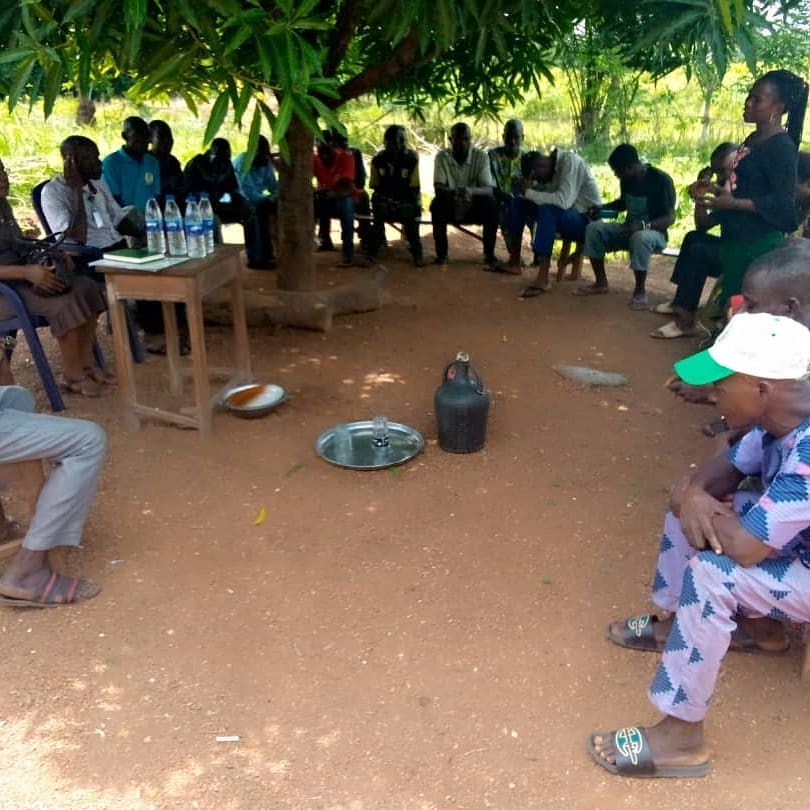
HRCRC Anchors Ebonyi Guber Townhall Meeting

HRCRC Anchors Ebonyi Guber Townhall Meeting
HRCRC Anchors Ebonyi Guber Townhall Meeting- As part of our Peacebuilding efforts and Good governance mandate, HRCRC’s George anchored a town hall meeting with gubernatorial candidates of Ebonyi State in the forthcoming general elections. Organized by @nhrcnigeria – National Human Rights Commission Ebonyi State, with support from international partners and in collaboration with Ebonyi State Civil Society Network / Situation Room, the event also saw the endorsement of the Vote not Fight National campaign and the signing up to Peaceful conduct of the electioneering process by all candidates present.

Conflict Resolution in Amagu Ikwo

Conflict Resolution in Amagu Ikwo

Conflict Resolution in Amagu Ikwo:

Conflict Resolution in Amagu Ikwo

Resolving Conflicts at the grassroots ultimately prevents larger compound Conflicts… HRCRC on another workaday visit to Amanguru Amaeka Ikwo in Ebonyi state for Dispute Resolution…

DNA Test/Marriage Under Customary Law

DNA Test/Marriage Under Customary Law

DNA Test/Marriage Under Customary Law: DNA test not only proof of paternity under Nigerian law’

Prof.-Nnamdi-Obiaraeri
Following the arguments and interest generated by the proof of paternity of children under Nigerian law, Prof. Nnamdi Obiaraeri argues that DNA test is not the only acceptable method of determining paternity of children in the country as posited and presents what he calls a balanced narrative by exposing how paternity can be proved under yet another branch of Nigerian law, being customary law.
I have had the privilege of reading an earlier intervention by Durotimi David Owoeye titled “DNA TEST AS PROOF OF PATERNITY: THE CURRENT POSITION OF NIGERIAN LAW”, wherein he ably captured the position of only one out of the two systems of laws applicable in Nigeria on use of DNA as proof of paternity.
Amidst rising rates of infidelity including paternity fraud in Nigeria and in view of heightened public interest generated by the controversial issue of recourse to DNA as proof of paternity, it has become expedient to balance the narrative by exposing how paternity can be proved under yet another branch of Nigerian law, being customary law.
It bears repeating that the said article by Owoeye Esq did not address proof of paternity under customary law and has as such left many members of the reading public to think that DNA test is the only acceptable method of proof of paternity under Nigerian law.
The following may therefore be noted as a more comprehensive treatment of the subject matter of proof of paternity covering the dual systems of laws (statutory and customary) applicable in Nigeria.
The preliminary point must be made that customary law (including Islamic or Sharia law) is not inferior to received English law except where such customary law is shown to be barbaric being that it is proved to be repugnant to natural justice, equity and good conscience, incompatible with public policy or at variance with any provisions of a statute.
DNA test as proof of paternity is foreign, alien or unknown to indigenous customary law usages.
To prove paternity under customary law, what is needed is evidence of a subsisting marriage.

Thus, a DNA test is not needed to prove paternity if there is a clear evidence of valid and subsisting marriage under customary law.

This is also true of English law although customary law’s position on proof of paternity is more accommodating and can even be said to be in sync with the right to freedom from discrimination guaranteed under section 42(2) of the 1999 Constitution as amended to the effect that “No citizen of Nigeria shall be subjected to any disability or deprivation merely by reason of the circumstances of his birth”.
Customary law protects family bonds and privacy rights and jealously guards the marriage institution to the extent that no offspring of a valid marriage is to be discriminated against on account of the circumstance of his or her birth.
For instance, this is the general principle espoused in the Igbo customary proverb on paternity- “ebe nwa shiri lo uwa ya hiri”.
DNA Test/Marriage Under Customary Law, a paternity dispute is never between a husband and a male adulterer because the fact of valid and subsisting marriage creates a strong presumption of paternity in favor of the parties to the marriage.
Any child born during wedlock is presumed to be the product of that marriage.
Under customary law, where there is no marriage between the parties, (being between a woman and a man entangled with her in an amorous or illicit love affair) paternity dispute may never arise, and if it does, it is easily dismissed by the strong saying- “enyi anaghi enwe nwa”.
This is true, at least in Igbo land.
When literally interpreted into English, this means that a person who is not married to a woman but otherwise laying claim to the paternity of a child via an illicit or amorous relationship may not succeed in a claim for paternity if the woman or her family resists it.
Paternity can also be acknowledged under customary law usages, thus ruling out DNA test completely.
This customary law principle of “acknowledgment of paternity” posits that one does not to be the biological father of a child or to be married to the child’s mother to be the father of the child.

Presidential Distinguished Service Awards

Presidential Distinguished Service Awards

The Minister for Foreign Affairs and Minister for Defence, Simon Coveney, T.D. announced the recipients of the Presidential Distinguished Service Awards for the Irish Abroad for 2020.

The Presidential Distinguished Service Award was established following the 2011 Global Irish Economic Forum as a means to recognize the contribution of members of the Irish diaspora, and the first awards were made in 2012.

The 14 recipients demonstrate Ireland’s remarkable international influence. Their work has impacted so many, bringing joy through literature, theatre, and film; improving social policy, and providing care and support for the poor and underprivileged.
Below is the list of recipients of the Presidential Distinguished Service Awards;

PDSA Recipient 2020

Category

Location

Jack Charlton (deceased)

Arts, Culture and Sport

Britain

James W. Flannery

Arts, Culture and Sport

USA

Mitsuko Ohno

Arts, Culture and Sport

Japan

Fiona Shaw

Arts, Culture and Sport

Britain

Michael J. Dowling

Business and Education

USA

Sr. Louise Horgan

Charitable Works

Thailand

Alice Kennedy (deceased)

Charitable Works

Britain

Dermot O’Leary

Charitable Works

Britain

Loretta Cosgrove

Irish Community Support

Australia

William Duncan

Peace, Reconciliation & Development

The Netherlands

Sr. Patricia Murray

Peace, Reconciliation & Development

Italy

Fr. Kevin O’Hara

Peace, Reconciliation & Development

Nigeria

Michael Ryan

Science, Technology & Innovation

Switzerland

Dennis J. Slamon

Science, Technology & Innovation

USA

Human Rights and Conflicts Resolution Centre proudly congratulates our founder, mentor, Human Rights activist and Peace Advocate – Rev. Fr. Kevin O’Hara (SPS) as He bags another award from the Irish Government in recognition of his work in Peace Building, Conflict Resolution and Reconciliation in Nigeria.