Introduction
Elections are one of the canons of a democratic society. To many,
it signifies a time of rebirth, rekindled hope and transition. A time to retain power or oust an
unpopular incumbent from a political position and a popular candidate voted in. Youths look
forward to attaining the legal age to join in making this choice. It has become the voice of the
common man and a tool in making the peoples mandate shine. Without a free and fair
election, democracy becomes merely a theoretical concept only fit to be studied and theoretically analysed.
In societies where elections are characterizes by violence, gross electoral malpractice,
government interference and money politics, democracy is suppressed.
The 2019
elections have come and gone and the winners sworn in but the irregularities
that
characterized the process in Ebonyi
state still loom in the heart of its residents and electorates.
ROAD TO 2019 ELECTIONS IN EBONYI STATE.
Prior to the election there were grave concerns over the conduct
and possible outcome, many believed that just like in previous years, it may be marred with
violence. The campaign witnessed the annihilation of minor political parties and their
candidates; they were almost unnoticed due to inadequate campaign and poor press coverage.
There was
also the apprehension
of whether the election will take place in war prone zones in the state and a
growing concern over the safety of the
persons living in these areas during the election. Weeks leading up to the election, there were reports
of the attacks and disruptions of the All Progressive Congress(APC) rallies in Ebonyi,
Onicha and Ohaozara local government Areas of the state; also about thirty houses were razed
down at Izzi-west constituency in a politically inspired clash by political party members. It
was however alleged that these attacks were occasioned to inspire fear in the heart of the
electorates in the constituency and discourage them from voting. The streets were graced with
torn campaign posters and acid bathed billboard photos.
There were
rumours of planned attacks on the INEC offices around the state. This rumour
prompted a massive deployment of law
enforcement agents to the INEC offices around the state. This gave room for some unscrupulous law
enforcement agents, who took advantage of the situation to bully innocent civilians who dare
get close to the roads leading to these offices. The atmosphere further escalated tension in the
already tensed environment.
As the days
drew near, excitement once more filled the air as many travelled in and out
of the state to participate in the
elections. The excitement was however short-lived and election fever
once more crept in after the
Independent National Electoral Commission (INEC) announced the postponement of the election on ground of
logistics challenge and sabotage on the commission’s efforts. The presidential election was shifted
from the 16th day of February 2019 to the 23rd day of February 2019 while the governorship and
state legislative elections were shifted from 2nd march 2019 to 9th march 2019. Once more the
general spirit was downcast, the enthusiasm died and discouragement set in.
However in retrospect, the
rescheduling of the elections proved to be a blessing and a curse to the
peculiar Ebonyi polity. It was a blessing because it gave time for a dousing of
the already very pent up and potentially explosive polity that preceded the
postponement. Furthermore, security agencies had more time to plan and strategize
against new hazards that had not been anticipated.
It was a curse because democratically,
it discouraged many from coming out a second time to cast their votes in the
elections. This was especially true for those who had travelled to their home
polling units to exercise their franchise. It was very manifest in the very
abysmal turnout of voters during the elections.
THE ELECTIONS
On the 22nd day of February 2019,
being the eve of the presidential election, a politically
inspired attack was carried out on
some innocent individuals in a drinking bar in Ndiegwu
Amagu village of Ikwo local government Area of the state resulting in the death of
two persons while about three persons were severely injured.
Voting
commenced on each day at an average of about 9.40am, the level of voter turnout
was abysmally
low compared to previous years. A Factsheet on the elections in the state
revealed that there were about 1,459,933 registered
voters in the state, 1,299,043 collected their permanent voter’s card but only about
thirty-five percent of these came out to vote.
There were
isolated reports of violence in some polling
stations from the stationary and roving observers of HRCRC. Notably also were reports of
intimidation of the INEC ad hoc staff
in different polling units in Afikpo, as well as reports of ballot box snatching in Okposi
Umuagara. It
was also reported that in Oriuzo, a school building where the voting materials were kept was set
ablaze alongside the motorbikes belonging to individuals packed within the vicinity.
Youth
participation was relegated to thuggery by political overlords; even if not as rampant as prior elections.
Security agents and political thugs were used in the intimidation and
harassment of voters; voters in many
polling units also complained of being forced to thumb print ballot papers in the presence of law
enforcement agents who were eager to please their preferred candidates while browbeating
opposition party members into acquiescence.
Remarkably, there was widespread cases
of vote buying and inducements particularly in polling units in Ohaukwu local government area of the state.
Allegations of domestic observers influencing the election by coarsing voters to vote for their
preferred candidates cropped up as well.
A major
controversy of the Election process in Ebonyi is that in all the Local
Governments Areas in the state except Abakaliki Local Government Area, there was a major discrepancy
between the number of registered voters in the presidential election and governorship
election.
Though tales of these vices trilled
the air during the elections, it is also worthy to note there was
peaceful election in different parts
of the state.
HRCRC’s EFFORT
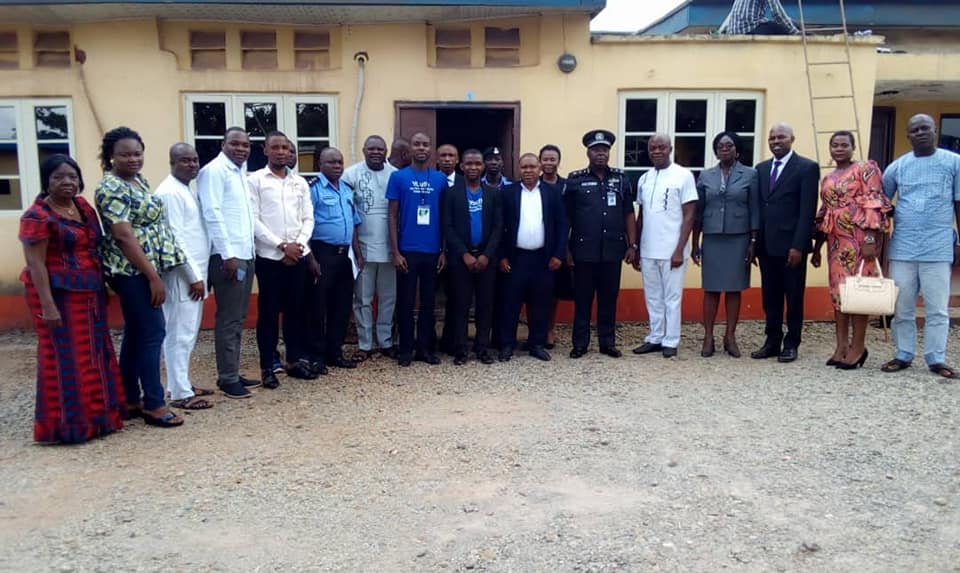
In a bid to ensure peaceful election in the state, the HRCRC did
the following:
- Implemented a Peace Electioneering
Project funded by the Irish Aid and St Patrick’s
Missionary Society geared towards
training on Non-Violent Response to Conflict formajor electioneering
stakeholders.
- Training for her branch members
across the state on effective Election Observation and
Reporting. - Advocacies to the Commissioner of
Police, the Comptroller of Prisons, Traditional Rulers and Town hall
meetings in each senatorial district
to ensure a nonviolent free and fair election.
- Conducted post-election
evaluation with civil society organizations with the view to
determine the impact of its election
sensitization project in the conduct of the election
and collect data on other electoral
issues.
RECOMMENDATIONS AND CONCLUSION.
- To curb bribery and vote buying,
the people should be empowered economically because
it is unlikely that one who is
gainfully employed and whose standard of living is high can
be bought out by unscrupulous
politicians bent on winning at all cost. - A bold and vibrant press can help
to guarantee credible elections. There should be a factual and balanced reporting of all election
related issue and effective early warning system put in place in areas prone to electoral
violence.
- Surveillance and recording systems
should be mounted on pulling units and collation
centres to ensure a more transparent
election. - Politicians should be made to
publicly denounce participating in any form of
electoral violence. Thus, they should
be held accountable by prosecution in violation of
these oaths or fined heavily. - Domestic and international
election observers should be timeously deployed in other to
effectively monitor elections. - Political parties should respect
their parties’ constitution and avoid undue influence on
party members to vote for a particular
candidate against their individual wishes. - INEC needs to
undergo continuous restructuring especially in areas of staffing and
staff development; and also imbibe the
culture of early training of ad hoc staff to ensure
effective service.
Overall, there was a drastic decrease
of violence in 2019 election in the state compared to previous electoral years but much is still needed to be
done to attain a better electoral atmosphere; an atmosphere devoid of voter fatigue, election
fraud, voter apathy, violence and other election related vices. In other to achieve this, we
must be ready to accept positive electoral reforms, take back the real power from the few unruly
politicians bent on forcing their will on the masses. We must be ready to hold each other accountable, and
ensure that our vote counts while shunning all forms of violence and bribery.