Blog

  • Growth… Onueke Branch Inaugurated

    GROWTH!!! Onueke Branch Inaugurated. Thus bringing the number of HRCRC active branches around Ebonyi to 28…
    Increasing grassroots reach and engagement… more hands helping to build more peaceful and just communities… Contributing to making a better and safer world from the little communities.

  • First Board of Trustees Meeting 2018 / Change of baton

    On the 29th of May, 2018, the Board of Trustees of HRCRC met at the Theresa Ozo-Nweke conference room in HRCRC office complex at 10 am. In attendance, the founder of HRCRC – Fr. Kevin O’Hara, the chairman of the board – Professor Mkpa Agu Mkpa, Secretary of the board – Barr Mike Ajawachuku PhD, Princess Alu Ibiam and Mr Okorie Christopher. Also present was the outgoing Acting Director – Dominic Okoliko and incoming Acting Director George Etamesor.

    During the meeting, several issues aimed at the development of the center were extensively deliberated after which there was a photo section with members of staff.

    The next biannual meeting is expected to hold in November 2018.

    Our prayers, gratitude and well wishes go with Mr. Dominic Okoliko as he leaves us for a widening of his horizon. We thank him for the developmental initiatives he began during his short but very eventful leadership of the center.

  • “HUMAN RIGHTS” GAVE ME A FATHER, A FORTUNE AND A FUTURE

    By Emmanuel Nweke

    {This narrative is based on a true-life story from HRCRC archives. But to maintain confidentiality, the names of persons and places appearing in it have been changed. Any similarity with persons or places is mere coincidence. The story itself reflects the work we do and the value we place on building relationships.}

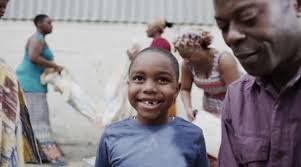
    [picture, courtesy of dissolve.com]
    This was the hilarious and grateful exclamation of a hitherto confused and somewhat hopeless boy of about fourteen years old. Chukwuma had known his mother, late Mrs. Grace, and her husband, Mr Ugadu, as his parents while growing up. But that was until recently when series of events started turning his world about.

    It all began when Chukwuma was born out of wedlock as a result of failed relationship between his late mother and her erstwhile boyfriend. At about four years after Chukwuma’s birth, her late mother, Grace, from Izzi extraction, in Ebonyi State, was given in marriage to Mr. Ugadu, from Ngbo in the same State, alongside Chukwuma, to avoid leaving him without a father. Chukwuma was too young to comprehend or suspect that Ugadu was not his real father as he enjoyed every form of peace and comfort, especially through his loving, enterprising and relatively rich mother. His mother bore five more children to Mr. Ugadu whom Chukwuma lovingly respected as his siblings.

    Tragedy struck when Grace suddenly became sick and died. It became tough on Mr. Ugadu to attend to family responsibilities since his supportive wife was no more. Ugadu’s immediate line of action was to gradual withdraw his affection towards Chukwuma. The latter was abruptly withdrawn from school while his siblings continued theirs. As time passed, Ugadu’s preferential treatment was extended to welfare. While the other children enjoy good meals as at when due and were fairly clothed, Chukwuma was denied feeding and clothing. These treatments got him very confused and disturbed. However, the handwriting on the walls were yet to be fully comprehended by Chukwuma.


    One day, in anger, when he was deprived of food, he asked Mr. Ugadu whether he was no longer part of his family to deserve such ill treatment.  In reply and in a fit of rage for his daring to question him, Mr. Ugadu opened up: “you are not my son. You have never been”. This shocking revelation to Chukwuma was equally followed up with physical beating. He was then thrown out, banned from returning back to a place he had always known as his home. In complete confusion and pain, he was directed to Human Rights and Conflict Resolution Centre (HRCRC) in Abakaliki for help.

    When HRCRC intervened, inviting and interviewing relevant parties, the maternal grandmother of Chukwuma made further revelation concerning the boy’s biological parents. It was learnt that Chukwuma’s biological father wanted the boy and the mother so earnestly but Grace’s family refused him because of his poverty. When Mr. Ugadu was invited by HRCRC, he denied ever maltreating Chukwuma and insisted that he was his son. But when he was asked to undertake in writing to send Chukwuma back to School and take adequate care of him, he vehemently refused, saying: “I have not finished taking care of my ‘real’ children let alone this ‘bastard’”.

    It was at this juncture that Chukwuma’s grandmother revealed the true identity of the boy’s biological father, Mr. Nwibo. Unfortunately, Mr. Nwibo had died out of frustration. The old woman however, pointed out that Chukwuma has a number of uncles still living and would be very willing to accept the boy into their home.

    HRCRC proceeded to invite the brothers of Late Mr. Nwibo. They were delighted to learn of the truth concerning their late brother’s son. They accepted to welcome Chukwuma into their family and perform the necessary rites. On the part of Ugadu, he further revealed that he only took in Chukwuma and tolerated him that much because the boy was part of the conditions given him before he could marry Grace, his late wife.  HRCRC therefore, handed Chukwuma over to his biological relations. In a mood of joy and happiness, Chukwuma let out a loud sigh of relief exclaiming: “thanks to HRCRC for giving me a father, a fortune and a future”.

  • ‘Ugwu Elom Onele’: The ‘Juju’ Hill

    ‘Ugwu Elom Onele’: The ‘Juju’ Hill

    By Dominic A. Okoliko

    The road leading to Ugwu Elom Onele snake-curves with dimples here and there, so that gliding through it makes you feel as if you are doing a jingle. Whether you are walking or on the popular Okada or in a vehicle, the feel is the same; one time you’re tossed up, then down, or a twitch to left or right. These huddles faint before the overlooking figure of Ugwu Elom Onele, “the Juju Hill”. It rises stubbornly as you approach it. With a proud towering and a robust base, its sturdy appearance can be intimidatingly inviting. As one braces up against it, it seems to rush at you for a welcome. Yet, its pride would not make it bend an inch. Instead, it is you that would cringe and crave at the same time. Yes, you would pant and gasp with a yearning for its embrace. Is it not how all spiritual places are?

    Talking about the spiritual, Ugwu Elom Onele present an ambience of mystery. On the hill top, there seems to be a double fold movement between the earth and the heavens, the joining of nature with the divine. No wonder, the locals used to call it ‘the Juju Hill’, a sanctuary for the deities. Legendary account has it that the huge assemblage of earth that stand tall among its peers was once a feared and revered place. Dressed in a beauty of greens, shrubs and a whole collection of bushes; one hardly can avoid its attraction or fail to recognise the sacredness it bears. Yet, it was said that hardly would one see people walk up the hill if there was no cause to do so. The only exemption then was Elom Onele, the chief Priest of the deities whose spirits pervade the being of the hill. He lived there, under the fortress of the hill and in company of servants, communing day and night with the gods, nature and humans. This is why in the local language, the hill is called “Ugwu Elom Onele” meaning, “the hill of Elom Onele”.

    Elom Onele must have been dressed in a regalia close enough to blend well with his surrounding; a surreal appearance of some earthen vest with enough perforation to allow the skin to welcome all the elements. Then the eyes, those sharp eyes, dressed in white chalks present a mirror of a half moon. His look must have been terribly sublime enough to make anyone wanting to stare too long to stoop and content with his bare foot being massaged by the raw and rough stones that decorate the hill. Yet, he was the medium between the people and the deities of the hill.

    Whenever the locals experience a dread, a sickness, or see a peace disturbed, the individuals, families or communities involved would go up there. They would consult and sue for solace. They would long to hear the whispers of the hill and the thunders of its roars. Elom Onele was the mouthpiece. Words have life on his lips. They pour out like rain, only that they are erratic and sometimes distant. The ears that must hear of them, like the legs that carries them up there, must make an ascent. They must rise to the beyond, to the peak of the hill where they can catch a glimpse of ‘everything’. You never fully grab it though. There is always a feeling of wanting more; that feeling that makes you look forward to another visit. Sometimes, the words are like oil. They caress and dress wounds. Other times, they are hammered into spears. They lash and cut through one’s loins until they leave one naked with innocence.

    Elom Onele must have breathed in too many breaths of the hill where both divine and nature meets. That is why he is thought to possess such potency. But that was Ugwu Elom Onele of yesteryears.

    If anything has changed about the hill today, it is hardly the hill itself though. The sturdy and proud look remains. The awesome beauty of its environment is still a point of attraction. And while modern growth of Abakaliki City has caused the hill to give up its watch over the vast heavy spread of vegetations that used to cover the surrounding, Ugwu Elom Onele still maintains its virtue, a lush woodland hosting collection of arboreal, creeping, humping, flying and many species of creatures.

    The heritage Ugwu Elom Onele has gathered over the years have made it a crowned pride of Abakaliki. Now under a ‘christened’ name called ‘Hill Top’, its symbolism and sacredness continue to make it an appealing scene to visit. There’s hardly a day or an hour that Ugwu Elom Onele does not entertain visitors in its present form. And like of old, the pilgrims come out to meet the hill for various reasons. There are many who made their ways up the hill for prayers. Others do so to experience some quiet time while some ascend there to simply experience the aesthetic wholeness the hill portends.

    There is another new and important feature that the hill now carries. The old Elom Onele and his sanctuary have been replaced by a beautiful edifice whose commitment is to embrace all people fatigued by life scourges and to offer help in guiding them to experience solace and peace. The new sanctuary goes by the name Human Rights and Conflict Resolution Centre (HRCRC). HRCRC stands half-way up the hill, adding a mix to Ugwu Elom Onele’s ambience. At HRCRC, you will meet a collection of Elom Oneles dressed in welcoming smiles and eager feet that itch to rise for you. They provide listening ears and are skilled in divinizing issues of social injustice, violation of individual rights, relationships and contract breaches, and other things that injure community and personal peace.

    HRCRC as the new oracle from Ugwu Elom Onele is a voice whose thunders and whispers have been heard and sustained within Ebonyi state and beyond. Its tentacles spread as far as the boarders of Abia, Enugu, cross River and Benue States and have a legacy that goes back to 27 years ago. Like the hill where it is located, it has become a life, a heritage with rich testaments.

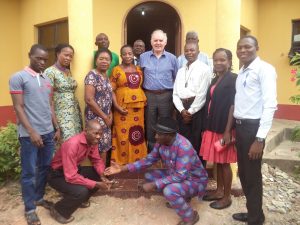
    This picture was taken when the Founder, Fr. Kevin O’Hara (SPS) visited HRCRC after the renovation of the Office Complex in Nov. 2017
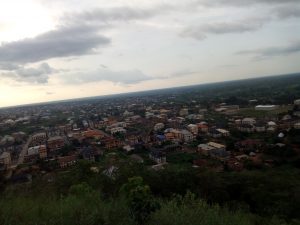
    A view of Ai City from the top of Juju hill
  • Introduction to ‘Know Your Right’

    Introduction to ‘Know Your Right’

    Hello!

    It is KNOW YOUR RIGHTS project. From HRCRC, Abakaliki, we are glad to share this maiden edition with you. Our task today is simple: we want to introduce you to the project.

    Think of this story. Ajole is a princess, a daughter of a late wealthy king. Ajole however, did not know who she really was as she was raised by a distant relative. The relative kept the truth about her status from her because she feared she might lose her grip on Ajole as she had overtime, grew to become very close to Ajole. Under this circumstance, Ajole lived in the land like a common folk. Because she did not know who she was, she could not demand to enjoy the privileges that were her due as a princess of the land.

    Many people living in our communities today are like Ajole. They have little clue about the weight their status as a citizen of the Federal Republic of Nigeria carries. They equally know less about what forms their rights as humans, beings endowed with certain privileges (rights) which should not be denied. These privileges are not theirs because they are in Nigeria, but specifically because they are human beings. This is why article 1 of the UN Universal Declaration of Human Rights says: “All human beings are born free and equal in dignity and rights”; and with this understanding, article 2 adds that enjoying HRs is not based on distinction of any kind (race, colour, sex, language, religion, ideology, nationality, origin, soical status, etc.).

    Another dimension to ignorance about rights concerns grievance mechanisms (ways individuals can seek redress for violated rights). What can one do if one’s rights is violated? Who can offer help to victims of rights violations? And what instruments of laws guarantees the protection of rights?

    KNOW YOUR RIGHTS is specifically designed to address these concerns. We want to expose viewers to basic knowledge on human rights. Because of the limitation of this forum (the need to keep post simple and short), our aim is rather minimal: to stimulate in our readers, enough curiosity to enable them seek knowledge about HRs and through this means, become empowered to promote and defend human rights as it concerns them and others.

    To start with, we will introduce today, the concept of human rights (HRs). Obviously, it concerns the human person, not just one individual, but human beings of all ages, cultures, states, races, ethnic backgrounds, regions, creeds, places and other categories that may be existing. HR principle says, this being called the human, possesses dignity and value (you can call it, God-given) which calls for respect. Systems, institutions, cultures, persons and anything else created by humans owe the being this obligation of respect. Thus, we might say, HRs are privileges that any human being qua (as) human being is meant to enjoy. To deny the human person this respect is to violate the person’s dignity and value.

    You can also think of HRs as fundamental requisites needed for each human being to lead a minimally good life. HRs include rights to life, liberty, education, fair hearing, etc (we shall explore these and others in subsequent posts). For instance, you will agree with us that when people’s need for security is met, they can have the opportunity to live and pursue self-developing goals. However, like Ajole’s relative, institutions have not helped to educate many people about these rights. Like her, they tend to consider it not necessary, perhaps, because acquiring such knowledge would shake status quos which benefit them.

    Thus, we consider it necessary to push back the knowledge gap and contribute to growing your awareness of rights issues and how to address them. We shall look at what constitutes human rights, what their attributes are, instruments that guarantee their protection, and mechanisms to address their violations.

    We are going to leave it at this junction (and please, do stay tuned for the upcoming post by next Wednesday). For today, what you can take home is this: If you don’t know what your rights are, you can’t know if they are being respected, protected and made real. Under same guise, you will not be able to ascertain the limits to which you must respect the rights of others. Meanwhile, to spice things up, why not drop in your contributions and questions pertaining to this post in the comment section. We will engage you and also follow them up in our subsequent post. And please, don’t forget to share/like our page/posts.

    Many thanks!

    Contributors: C. O. Ikegbunam Esq.
    C. A. Nwankwo Esq.
    D. A. Okoliko

    Disclaimer:
    This is a free educational material and not a source of legal advice. If you need any, please consult your lawyer.