
ARE WE READY FOR HUMAN RIGHTS? – by Precious R. Nwadike ESQ

Years ago, people came together and agreed on the essentials of a civilized nation and what it would take for us not to constantly descend to barbarism. The United Nations Declaration on Human Rights 1948, the African (Banjul) Charter on Human and Peoples Right 1981, which has been ratified by member states and codified in chapter IV of the 1999 constitution of Nigeria are products of our brave attempts not to become barbaric. These rights act as that shield which protects us simply because we are humans and alive, not because we are inherently good people, rich, law abiding tax payers, male or female. Some of these rights include: the right to life, the right to dignity of human person, the right to personal liberty, the right to fair hearing etc.

Human rights are moral principles or norms that describe certain standards of human behaviour and are regularly protected as natural and legal rights in municipal and international law. They are commonly understood as inalienable, fundamental rights “to which a person is inherently entitled simply because she or he is a human being regardless of their nation, location, language, religion, ethnic origin or any other status. They are applicable everywhere and at every time in the sense of being universal, and they are egalitarian in the sense of being the same for everyone. They are regarded as requiring empathy and the rule of law and imposing an obligation on persons to respect the human rights of others.

These rights are therefore very sacrosanct. However, we have not actually lived in the reality of these rights. In some parts of the world they are yet to be realized, and in other parts of the world like Nigeria and other developing nations, these rights are currently under attack. Recently, the Governor of a South-eastern state, in a closed door meeting with Human Rights agencies and other stake holders said that there was nothing like human rights. Even if there was, we are not ready for it as a nation.

News of security operatives and law enforcement agencies who bully citizens and capitalize on their ignorance to extort from them is not a rarity anymore. Arresting a person for being in possession of a laptop without the receipt and charging him for armed robbery; arraigning an accused person before a court that obviously lacks jurisdiction, leading to his further remand in prison until his case is filed at the appropriate court; rounding up any young person found within a 200 meter radius of a crime scene and charging them for the offence of cultism – a non-bailable offence in Ebonyi state – which implies that they are remanded and forgotten to rot in prison as awaiting trial inmates; are almost conventional in the Nigerian society today.

The deplorably slow pace of our justice system has become a clog in the wheel of justice. This has made many assume that these rights are merely privileges, the respect and adherence of which we cannot assert. This should not be the case. Sometimes when we talk about rights, it feels as though we subconsciously exclude children. The abuse and neglect of children is an awkward discussion to have. It raises emotions in us and it raises questions about who we are as a people and how we relate to one another. There is a better way to protect and nurture our children, because it takes a community to raise a child. But this also means that it takes a community to protect the rights of a child. These children also share with us the same inalienable rights as humans.

“We haven’t reached the level where we should expose these children to their rights. It will make them too assertive.” This was commented by a principal of a secondary school in Abakaliki during our establishment of the Child Right Club in secondary schools across Ebonyi state. Sadly, the view of this principal is no different from the views of many in Nigeria. Consequently, children grow up seeing their rights as mere privileges. However, we believe there is a need to sensitize both students and their teachers on the rights of the child. Protecting children should be everyone’s business.

Based on these prevalent situations, is it safe to aver that we are not ready for Human Rights? We all have and love human rights; our own and those of our family and loved ones. Unfortunately, it is the right of others that is a bit of a problem, probably because the acknowledgement of the rights of an individual connotes a duty on all others to respect that right. Sadly, we cannot approbate and reprobate at the same time. So, to fight for the rights of people (especially those handicapped by ignorance and other circumstances) is what we must do. It is what makes us human. It is what will guarantee the survival of our specie. This is the primary vision for the establishment of our organization. So the question of being ready for human rights is inconsequential until we answer this: can we survive without human rights?

HUMAN RIGHTS DIED ON SUNDAY – by George Etamesor

Once upon a time we would rush out at the sound of human click sounds – imitating the very fascinating Zulu ‘X’ sound –  and the accompanying moo. It was interesting to watch how little petite very handsome curly haired Fulani boys controlled these gigantic white sluggish mammals with horns; Ah Yes, the horns! That they valued the life of the animals under their charge didn’t really stir up debates. Instead we were impressed with their smooth carved crosiers; along with the little daggers they wore around their waists like Navy Seals in full combat gear. Also, very inspiring was idea that these little dark handsome curly-haired bundles of calm confronted wild beasts in the wild regularly with their daggers to protect their mammalian wards.

I suppose the wild beasts in the wild grew more ferocious for soon, during the harmattan when the human click sounds accompanied by the moo passed by, in the stead of daggers we saw machetes not on their waists but held on their hands seemingly nonchalantly but at a ready. Then we heard on the news that they now carried riffles to protect themselves and their charge from the ever-evolving dangers of the wild. Logically following this projection, soon they may need RPGs and grenades and the likes and, in a few years, when the issue of Nigeria comes up at the UN General Assembly, President Trump and Kim of North Korea will have to shut up because their quarrel will be petite in comparison.

Collectively, from the developing world of Europe and North America to the underdeveloped of South America, some of the far and middle east and indeed Africa, we have all managed to make a pleasant mockery of the Universal Declaration of Human Rights. All other inalienable right every human is entitled to just by being alive is pinged on the right to life. To pull off the hinge is to render quite redundant the door functionality of a door. If only humans beings who are alive are referred to as humans – dead ones are referred to as bodies or corpse -, and If every other right of a human is only valid because that human is alive, It therefore logically follows that by the wanton disregard and disrespect for the dignity of human life, so passionately and fantastically exhibited throughout the world today, we all have passively and actively destroyed the hinge on which all other rights revolve.

Ironically, while this rubbishing of all Human Rights in other climes have some sort of not justifiable in any sense but at least dignified push behind it, Nigeria chose to align herself with the less dignified kind of genocidal tendency; –  the ones that have an undertone reference to animals. Nigeria is proudly in the company of the likes of the Rwandan genocide – with their Cockroaches reference; but since we are the giant of Africa, why not choose a more gigantic animal – say Cows? Just why not? As if that is not enough disgrace, families and boarder communities continue to deprive people of their right to life in Ebonyi state over land disputes and sundry matters, the Izzis and Ukelles are killing themselves over something that happened before they were born; then kidnappers, cultists, ritualists, careless officers of the law, robbers – both armed and not, mob action/jungle justice and herdsmen graciously join in compounding the situation for us.

It was remarkable to read a leader make subtle comparison between the life of cattle and the life of a human being. The Miyetti Allah Cattle Breeders’ Association of Nigeria was alleged to have elusively said that the murder of more than a hundred innocent persons in Plateau State was a reprisal attack for cattle rustling in the town and even threatened –  sorry, cautioned that there would be no peace in the area because of this great crime against humanity – cattle rustling. Instinctually, my first reaction was with great deference to his fundamental human right to speech and opinion, how dare he make a subtle defence of the inhumane murder of human beings right in their houses and compare it to the killing and rustling of cows, and even daring to justify his stance by saying there will be no peace. And I am sure many other southern Nigerians shared similar or even less agreeable sentiments. Eventually, this news was found to be inaccurate. The sudden proliferation of hate speeches and fake news mostly born out of stereotypes and prejudices is both unhealthy and a catalyst for disintegration and possibly annihilation. But this is an issue for another day. Today’s issue is that just like clockwork, Nigeria reacted. And this is what I have a problem with.

Whilst we moan, whimper, sniff and scream about the evolving tactics of protection employed by these curly haired shepherds, why is the government and security agencies tasked with the simple duty of protecting and securing lives of Nigerian Humans, not livestock, not learning from their positive cum negative – depending on your perspective – flux of protection? Or is that asking for too much from agencies whose sole task is securing our lives?  Why can’t we learn to value human life like they value cow life? The curly-haired handsome fellows are being proactive while the rest of us – citizens, security agencies and indeed the political class/elected government are impressively reactive.

Soon after the news of the mass killing broke, the federal government as usual condemned the attack and as usual promised to bring the perpetrators to justice, and as usual promised to prevent a recurrence, members of the ruling and political class issued statements condemning the attack, the Nigerian Air Force deployed a Mi-35P combat helicopter and an Intelligence Surveillance and Reconnaissance (ISR) aircraft to Plateau State, the Commissioner of Police was replaced, and of course social activists protested and were as usual harassed by security agents. The impressive list of reactions goes on and on and on and all combined does absolutely nothing to comfort the grieving in Plateau State, resurrect those potentials cut short who just happened to be on the wrong end of a bullet or a machete, or even from experience prevent a recurrence. In fact, a week after the initial attacks, and all the reactions and follow-up politicising of the event, it was reported that another attack, with the same MO, in the same State, and by the same suspected handsome curly-haired fellows killed Human Rights again. And in a swift reaction, the Chief Executive of the Plateau State adjusted the already imposed curfew from 10pm – 6am to 6pm – 6am.

Human Rights are not passive, they are active. They are neither good nor bad, they just are. They are beyond the scope of morals or ethics or religion or I dare say even human judgement. Since their conferment is not reactive or a result of any human effort or dependent on any human factor, it is safe to aver that the drive to safeguard them be commensurate. Like the developing world, think-tanks and intelligence agencies should come up with -if they do not have already- operational preventive plans and measures for all foreseeable conflicts and attacks that are proactive; and if they cannot, they should bloody well say so, so that we can task persons both within and without our social entity to do so.

We cannot continue to wait for attacks to claim innocent lives and then go on a show of force to quell reprisal attacks or prevent the emotionally wounded to express their natural emotional frustration and revenge tendency. The hurt will result in a vicious circle of attacks and counter attacks that can breed hate and, well it just goes downhill from there. While the hypocrisy of persons, especially Christians rejoicing over reprisal attacks is glaring, it is also emotionally understandable but out rightly condemned. The murder of Zayyan Gwandu, son of the Commissioner of SARS – Haliru Gwandu Abubakar for example is not only crazy but also senseless and irrational; and would remain this way until someone convinces me that he was among the group of first attackers. And even after then, it would be illegal to deprive him of his right to life haphazardly without due recourse to legal procedure. One can understand the lack of faith in the security and legal system in Nigeria as one of the major reasons why mob action and unjust jungle justice is prevalent.

Also, professional conflict resolution experts should be employed to help intervene in these cases and their recommendations be implemented.

The Term “Next Of Kin” Simpliciter, Does Not Confer The Right Of Inheritnce On The Person So Named: Of What Use is the term?

INTRODUCTION:

The meaning and the legal implication of the term “next of kin” have been constantly misunderstood by the ordinary public. It appears, though erroneously, that many people think that once you are appointed the next of kin of a person, it automatically gives you the right to inherit the person’s estate upon his demise. In fact, many people think that, a next of kin gives an exclusive right over a person’s property.

The above erroneous believe and understanding of the term next of Kin has made many people to shy away from the need to make a Will. This is because, they think appointing a Next of Kin, is a way of naming your beneficiary. However, the above assumption is not in conformity with the law. It must be noted that, ignorance of the law is not an excuse.

WHAT THEN IS THE MEANING OF THE TERM “NEXT OF KIN”?

The term, next of Kin has been described as the nearest blood relative of a person. See JOSEPH v FAJEMILEHIN O.O & Anor (2012) LPELR-9849(CA). The term can also refer to a person who can be contacted or notified in cases of emergencies or eventualities. For instance, one of the forms that is usually filled while on transit, requires the information of next of kin. This is needed in case of any accident. In other words, where there is an accident involving that person, his next of kin shall be notified or informed.

Also, the term is constantly put into use by hospitals. In this case, next of kin means a person who can make medical decisions for a person who is incapacitated or unable to do so, during emergencies.

The term is also frequently used in financial documents by banks and other financial institutions. In this instance, next of kin means a person who can ensure that the proper steps are taken towards the recovery of the money held at the bank, at the demise of the owner. In other words, being a next of kin of a person, as regards his money in the bank, does not give a right to inherit such money, either partly or as a whole.

WHAT IS THE LEGAL IMPLICATION OF THE TERM NEXT OF KIN AS IT RELATES TO THE LAW OF SUCCESSION?

It must be noted that appointment of a next of Kin is not a substitute to the making of a valid WILL. The reason is because, when a person dies testate (that is, the person made a valid Will), the matter of next of kin is of no relevance. The estate of a deceased person who dies testate is distributed strictly according to the Will. Thus, his next of kin will only be entiled to his estate, if the WILL says so.

On the other hand, in a situation where the deceased died intestate (that is, without making a valid Will), the question of the distribution of his estate is governed by the law. The customary law/Islamic law or the Administration of Estate Law will apply depending on the kind of marriage contracted by the deceased. In other words, if the deceased contracted a statutory marriage (popularly known as court marriage), the distribution of his estate shall be governed by either the English Law or the Administration of Estate Law. See OBUZEZ V OBUZEZ (2007) 10 NWLR (Pt.1043) 430. It must be noted that the Administration of Estate Law provides for the order of inheritance which must be complied with strictly and a next of kin, is not among the categories of those entitled to inheritance in this instance.

In other words, Succession is regulated by law. It is only those entitled by law to inherit a deceased person’s estate that can do so. A next of Kin is not one of such persons. However, this is without prejudice to his right to inherit on a personal ground. Thus, if the person so named as a next of kin is the son of the deceased, he is entitled to inherit, not as a next of kin, but because he is the legitimate son of the deceased. Also, if the person so named as a next of kin, is also named in a valid Will made by the deceased, he is entitled to an inheritance not because he is a next of kin, rather, because, he is named in the WILL.

CONCLUSION

A next of kin, who is usually a blood relative, though not always, has no legal right of inheritance by virtue of his status as a next of kin simpliciter. However, it must be noted that the appointment of a next of kin is not a means or method of naming an heir. A next of Kin is not recognised as an heir under the Nigerian law of succession.

Therefore, next of kin, stricto sensu, does not by any stretch of imagination, entitle the person so named an automatic right of inheritance. If the person so named as a next of kin is not entitled either by the WILL or by other laws of inheritance, to inherit, he cannot be conferred with the right of inheritance by the mere fact that he is named as a next of kin.

It is hereby submitted that when it comes to the law of succession, the term next of kin has no legal implication. It therefore does not confer the right of inheritance. Thus, it is erroneous and unlawful for anyone to claim any inheritance on the singularly reason that he is named as a next of kin. Such claims have no legal bases and are unfounded.

Thanks

© HURIDE Abakaliki Whatsapp Group

PEACE ACCORD between Amaebia and Amuzu communities in Onicha LGA of Ebonyi State

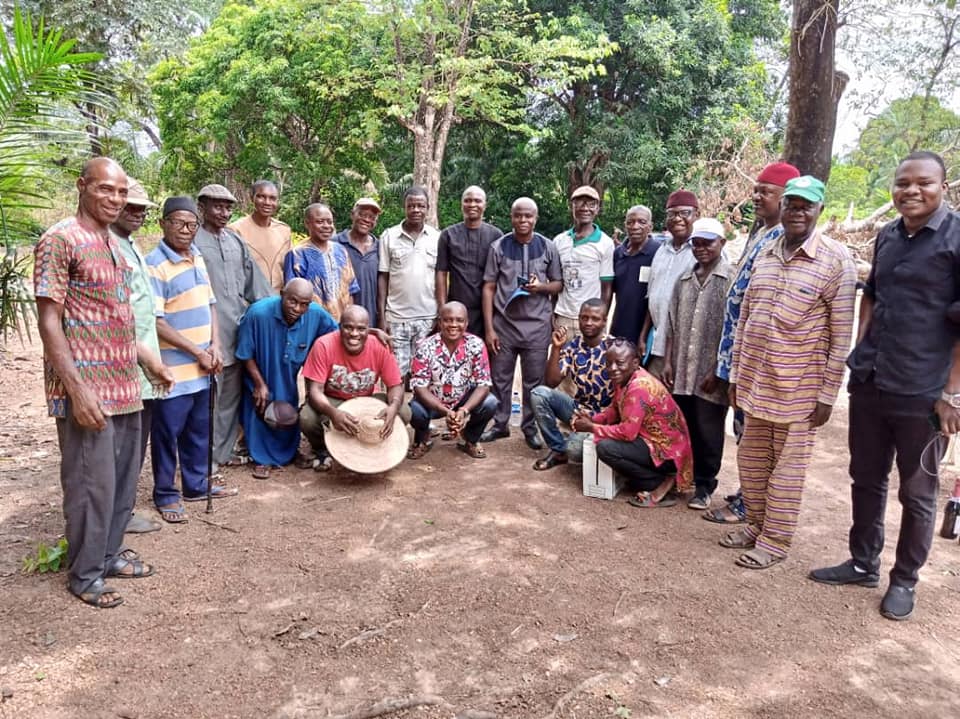
Amidst the COVID-19 pandemic scare, with great caution whilst practicing precautionary safety and hygienic measures, HRCRC witnessed the signing of a PEACE ACCORD between Amaebia and Amuzu communities in Onicha LGA of Ebonyi State.

The boundary dispute which was fast degenerating was mediated on and resolved by HRCRC through the instrumentality of Glorious Living Church.

HRCRC is proud to share the success story of Peace over Conflict which attracts more publicity. Whilst also sensitizing on the COVID-19 scourge, leaders of both communities inspected the agreed boundary and beacons, before signing the Peace Accord and performing a Reconciliatory Rite.

Thanks to all the parties for embracing Peace.

Violence Against Women and Deprivation

In recent months, Statistics of cases reported to HRCRC have indicated that one of the primary types of abuse perpetuated against women and children in the society today is Neglect and Deprivation. This trend calls for increased awareness, intervention and enlightenment targeted at families and the society.

Several legal instruments such as the Child Rights Act / Laws, Violence against Persons Prohibition laws have confirmed that women and children can be abused by neglect and deprivation.