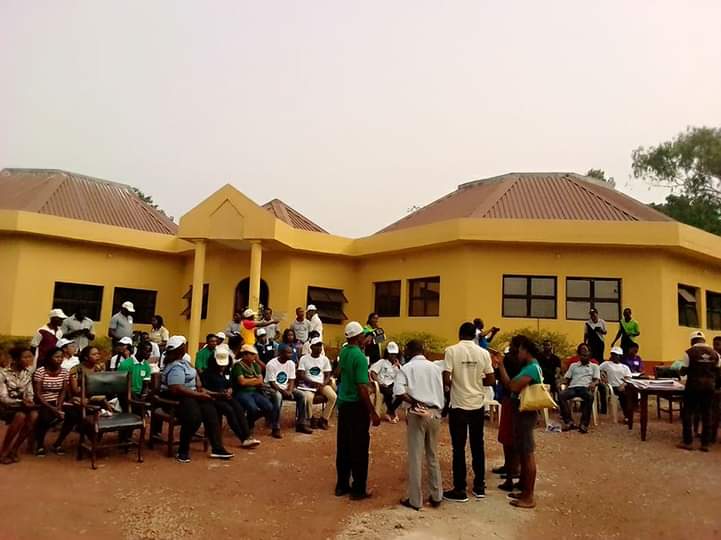
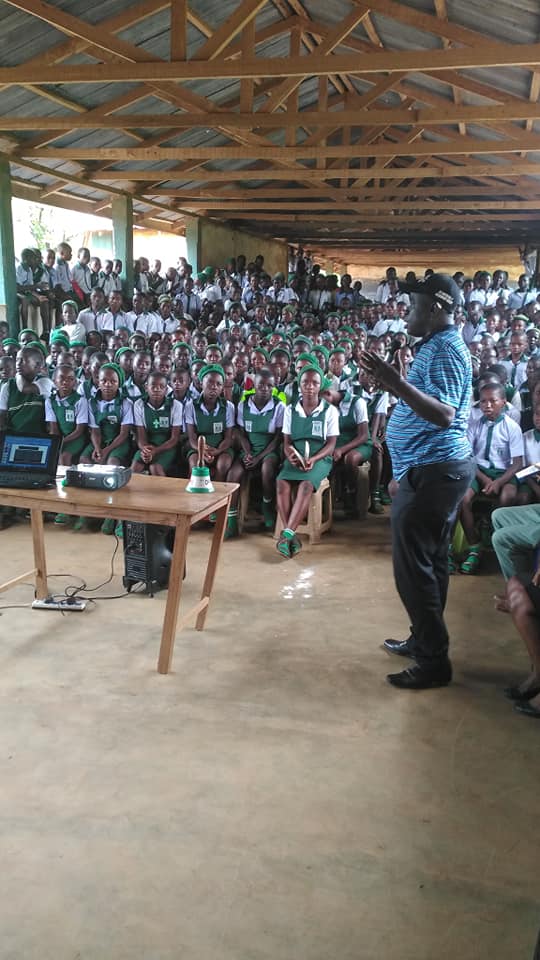
A core part of HRCRC work is on Child Protection and sensitization. Along with Raphael Ukusaga, – the designated child safeguarding officer of St Patrick’s Missionary Society SPS West Africa District, our mother organization – HRCRC visited Comprehensive High School, Oriuzor in Ezza North to sensitize her teachers and students on child rights/Protection and revitalize the child rights club in a bid to sustain the awareness campaign.
Also, we visited the traditional rulers of the Ezza nation for same purpose…
Furthermore, the resource person; Mr. Raphael Okusaga, Child safeguarding officer of St. Patrick’s Missionary Society, West-Africa region during a training for all workers and volunteers of the organisation across all our branches in Ebonyi state.
The Child Right Act (2003) is a legal instrument that provides for the measures meant to ensure the development and protection of children. Vulnerable adults are persons who, though above 18years are dependent on others by virtue of old age, illness, mental incapacity, etc.
The traditions and rituals of our communities have an impact on how children and vulnerable adults are valued and cared for.
We are committed to ensuring that our values, beliefs and attitude towards children and vulnerable adult are tailored into influencing our ability to act to towards safeguarding children and vulnerable adults.
HRCRC is embarking on a tour of secondary schools in the state with the aim of reawakening and revitalizing ‘Child Rights Clubs’ in schools in the state. The ultimate aim of this Catch them young project is to develop the already established platforms by creating more clubs in more schools across the state and engaging these students and teachers in trainings and seminars on the need and how to participate in the process of governance – by holding government accountable, respect and appreciation for the rule of law and justice, and the dignity of the child; through competitions, quizzes and debates and other activities aimed at sustaining the interest of the students. Expected outcome of the project include:
A more educated, vibrant and politically involved younger society as opposed to apathy grossly exhibited now and increased willingness to participate in governance and principles of democracy.
Yesterday, HRCRC kicked off with a visit to Presco Secondary School, Abakaliki.
In Collaboration with Christ Apostolic Church, Ishieke in Oshiri, Ebonyi state, HRCRC seized an opportunity to sensitize young people in a program about Human Rights, their rights, and what we do; whilst fanning into flame the passion for justice, peace and appreciation for the rule of law, HRCRC set in motion the process to have an indigenous branch established in the community.
Preaching the gospel of Justice, peace and equity were George, Chika, Chioma (Esq) and Emika (Esq)
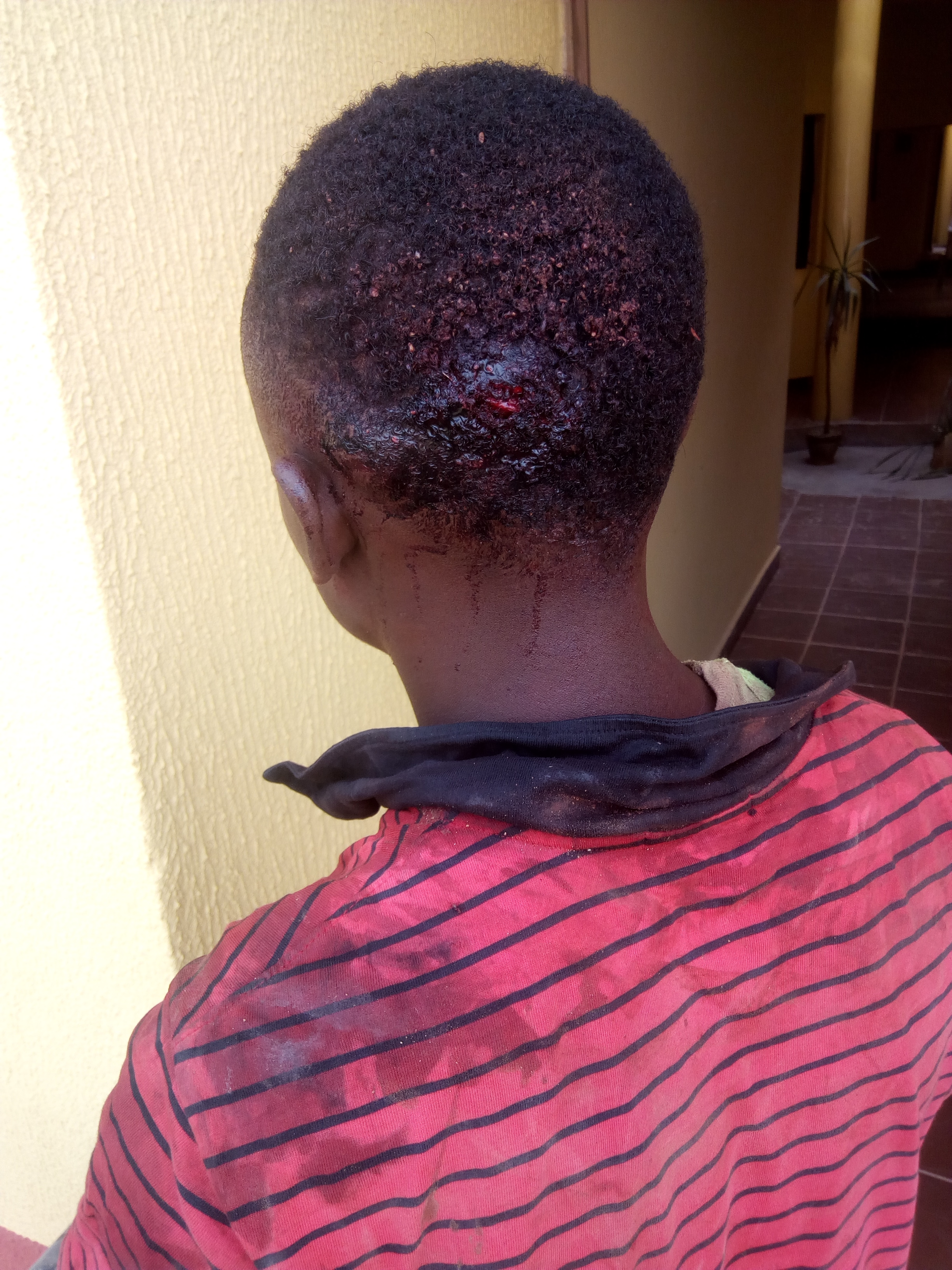
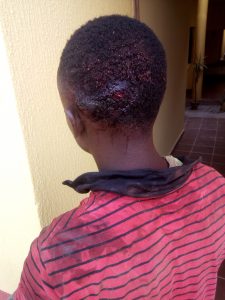
Earlier this year, a young boy ran to our office crying for help. He was physically distressed and had a deep and fresh wound on the back of his head. The boy’s face and shirt were terribly stained all over by blood. He told us, his father inflicted the head-injury on him, and that it was not the first nor the second time he had suffered similar fate from his father. A team of HRCRC staff followed the boy to his parents’ home for fact-finding mission. It was discovered that his father had inflated the injury on him because of his ‘stubbornness’. When the father was found and questioned as to why he had to beat his child to that extent, he bluntly said: “na you go teach me how I de take raise my children? Na my child e be na. Ah! I can do whatever I want na. Forget tha’una human right thing. Na oyibo matter o. Here na Naija abeg”.
Like the father of the boy referred to above, many believe that the entirety or some aspects of human rights (HRs) claims are not applicable to some persons (sometimes, because of the location, race, gender, culture, religion, profession, and other accidental attributes of such persons). Others (especially in Africa) even hold it that the notion of HRs is alien to them. To these persons, gender equality, social equity, child rights, fair wage, and other issues on the fore front of international struggles to improve human conditions are simply noises from individuals who are probably seeking attention and sympathy.
The assumptions alluded to above are misconceived, and it is what #KnowYourRights post this week wants to address. Rights due to A because A is a human person should not be denied to B if B is a human person. This is simple logic, and it is the basis of the universality of rights. If you were to find “the lowest common factor” between a child living in America, an adult woman in Asia, and an adult man in Africa, you cannot avoid the conclusion that they are all human beings. Our common humanity demands that we all share in equal dignity. Hence, the forms in which our humanity manifest (that we are black, male, female, pastor, son, wife, physically challenged, from the east or west, a Christian or Muslim, etc) is inconsequential to the obligation we all owe each other. It is that we are to respect human dignity wherever the human being exists.
If you consider the foregoing and relate it to our story, the boy’s father cannot absolve himself from gross failure to treat his child with human dignity by subjecting the latter to torture. His being a Nigerian (as if Nigerian laws permit that parents can do anything to their children) is immaterial to the demand of fairness in this case. In fact, Child Rights Act (2003), a federal instrument of law which has been domesticated in many states of Nigeria (including Ebonyi) expressly criminalises torture and other maltreatment of children. Also note that the law does not care whether such children are yours biologically or by other means (including acquisition for help or fostering).
In the case of care for children, the wise sayings of Nelson Mandela, the first democratically elected President of South Africa, is apt for consideration. Mandela once said: “We owe our CHILDREN the most vulnerable citizens in any society – a life free from VIOLENCE AND FEAR.” Whether a child is in Umuezekeoha in Ezza North LGA of Ebonyi State, or in New York City, the child deserves special care for the reason that (1) their dignity is the same, and (2), “Children [everywhere] are our most valuable resource” (Herbert Hoover).
To conclude thus, it should be noted that HRs are not some discretionary privileges that may be enjoyed by some and not all human beings (take home point for this week’s #KnowYourRights post). To drive home the strength of this assertion, Barbara de Mori (2002) succinctly puts it that HRs exist “independently of recognition or implementation in the customs or legal systems of particular countries”. In other words, the universality of HRS is such that cultural or other idiosyncratic claims about certain HRs tenets does not hold in reference to claims concerning HRs values.
Contributors: C. O. Ikegbunam Esq.
C. A. Nwankwo Esq.
D. A. Okoliko
The young boy with his wounded head
Disclaimer:
This is a free educational material and not a source of legal advice. If you need any, please consult your lawyer.
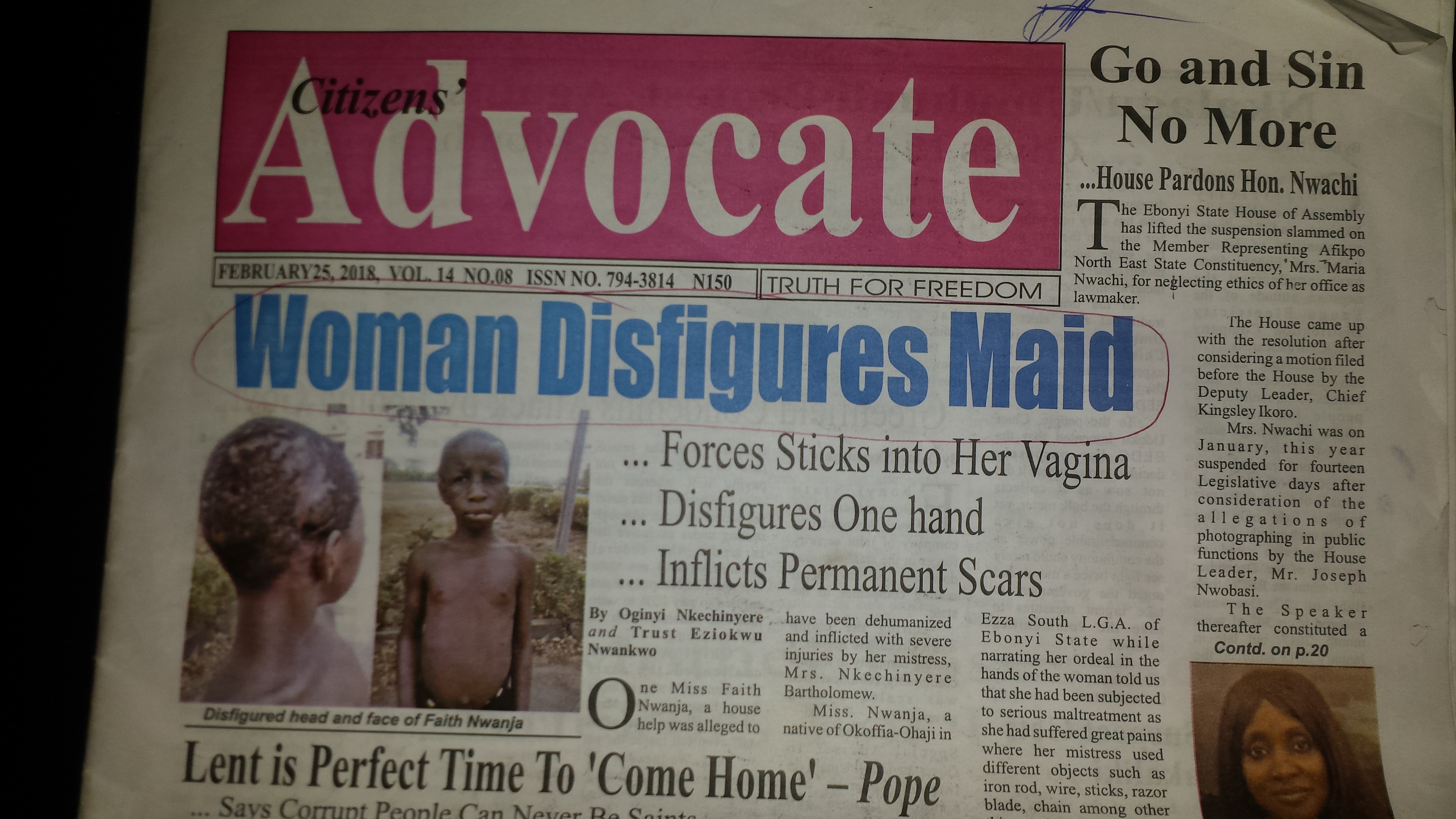
Recently a story about a 4-year-old girl, Uloma, made a headline in a regional newspaper, Citizens’ Advocate. Uloma was found in a slave-like manner under the watch of a certain woman, Mrs Nwali Josephine. The woman is not the little girl’s mother. Weeks before Uloma was discovered, she hawked for her ‘madam’, Mrs Nwali, with little care and feed. Her suffering was terrible such that when the Ministry of Women Affairs and Social Development found her, she was ill and had pultruding stomach indicating poor care and feeding.
You might be wondering how Uloma ended up with Mrs Nwali? Well, her mother, Veronica Igwe traded with Mrs Nwali at a rice-mill and could not pay up a balance of N 100. Uloma was then exchanged in place of the debt pending when her mother could pay. Now in the police custody over alleged child trafficking, Mrs Nwali and Mrs Igwe are wondering why anyone should frown at their actions. Was Uloma not freely given by her mother, and didn’t Mrs Nwali promise to return the child whenever she gets her pay back?
It is not difficult to see the error in the above reasoning. While the two adults engage each other in a contractual agreement, the involvement of the child problematizes their action. Child rights is a fundamental issue worldwide, and both Nigeria’s laws and international instruments have special provision for child rights protection. Often times however, interest of the child is rarely or never factored whenever adults take decisions that involve a child as it happened in Uloma’s case. The fact that children everywhere are generally dependent heightens their vulnerability. It is precisely for this reason however, that the UN Conventions on the Rights of the Child (CRC) {28/11/1989} sets out principles to mainstream child interest, such that in all nations of the world, for every act which may impact on a child, the interest of that child takes precedence. The African Charter on the Rights and Welfare of the Child, adopted at the General Assembly of AU in 1990 also prioritises child’s interest, insisting the child has the right to grow up in the family environment free from violence, fear and torture.
To step it down, beyond the provisions of the Nigeria’s Constitution in Chapter IV which sets out fundamental rights, and which in principle, are extensive to children, recent effort to give special consideration to the spate of child rights violation in Nigeria has seen the UN’s CRC domesticated as Child Rights Acts in 2003. Many states have keyed into the federal Act by enacting laws to that effect including Lagos, Ebonyi (in 2010), Enugu (in 2016) and 21 others (living 12 more states behind).
Despite this effort however, more Nigerian child are exposed to violence and abuse ranging from physical to psychological and sexual. The fact that recent survey (2014) by the National Population Commission (supported by UNICEF and the US Centres for Disease Control and Prevention) indicates that 6 out of 10 children experience at least one form of violence before their 18th birthday should make us all to shudder and awaken in us a sense of urgency to campaign aggressively against child rights violations in our society. Nelson Mandela made a remark that has import for this call. He once said:
“Safety and security don’t just happen, they are the result of collective consensus and public investment. We owe our CHILDREN the most vulnerable citizens in any society – a life FREE from VIOLENCE and FEAR”. It is up to you and us to ensure we don’t have more Uloma situations in our communities.
When it comes to human rights, we must not forget that existence of a law giving express protection to them is not the only ground to ensure their respect. This point has been made in a Journal of Jurisprudence (2010), vol. 1, by Gumbis, J. et al. who argues that “the fact that a person has rights has nothing to do with enacting these rights in legal document”. It is rather embedded in the natural principle upholding human dignity. Thus, legal lacuna can never justify actions negating human dignity in any clime.
Shalom!
Contributors: C. O. Ikegbunam Esq.
C. A. Nwankwo Esq.
D. A. Okoliko
Disclaimer:
This is a free educational material and not a source of legal advice. If you need any, please consult your lawyer.