Blog

  • MY RIGHTS AS A PERSON

    MY RIGHTS AS A PERSON

    Welcome to our second post on Know Your Rights media project.

    Our interest today is to understand what constitutes rights for an individual, and how this relates to other peoples rights. As usual, we shall begin with a story.

    Evelyn and Sandra were very good friends. It happened that both friends became pregnant with Sandra being in her 9th month and Evelyn 2 months and 2 weeks less. One day, they both got into hot quarrel which eventually led to a fight. In the process, Sandra gave Evelyn a heavy kick on her pultruded stomach. Both friends developed pregnancy complications as result of the fight. Sandra immediately went into labour, was rushed to the hospital and delivered a baby girl with much ease. On her part, Evelyn equally got into premature labour and had to be forced to deliver a premature baby girl through C-session. For Evelyn, it was a narrow escape as both mother and child nearly missed chances. Evelyns husband is furious and wants Sandra to pay for the problems she caused, including the pains and trauma he went through during the trying times for his wife. Sandra and her husband believes the problems wouldnt have arose were it not for Evelyns running mouth. The neighbours who witnessed the fight, and many of whom had to assist the women to access help were equally disappointed of the duos public nuisance

    About this story, we might ask:

    $Does Sandra have a right to react to provocation?

    $To what extent can she react?

    $Do the two women need to consider the impacts of their actions (fighting) on others (the babies in their wombs, their husbands and the neighbours)?

    These questions are key to understanding the scope and nature of rights as personified realities. It is true that as an individual human person, I am meant to enjoy certain rights/privileges without inhibition. But how are my rights related to those of others in my web of relationships? For instance, under the pretence of freedom of expression (enshrined in Nigerian Constitution and laws), many believe that they can go about saying anything about any person regardless of the truth-content of their expressions. Such a people represents Evelyn in the story above; they seem to possess running mouths. In similar nature, the rights to self-preservation covered in international instruments like UN Universal Declaration, article 3 (right to life, liberty, personal security), is sometimes interpreted to include unbridled act of self-defence at the slightest provocation. This is the case of Sandra in the story. She and her husband felt justified on the ground that Sandra acted out of provocation.

    The point missed by these people (the Evelyns and Sandras) is that rights and responsibilities are co-extensive. They always go hand-in-hand; hence, the saying, YOUR RIGHTS STOP WHERE MINE BEGIN. While rights are fundamental privileges that are everyones due, they are never absolute in the sense that it considers relationships. This is why Okpara Okpara writes in Human Rights: Law & Practice in Nigeria (2005:42) that every human being is both the subject and object of rights. As subject, the being is expected to initiate actions to further the respects of rights, and as object, the being is a recipient of respects of rights. If we understand this correctly then, as we demand respect of our rights from others, we would equally deem it fit to extend it to others.

    Consequently, it is important to highlight the responsibilities of the two women to the babies in their womb. Especially, in the context of Nigerian law which considers the foetus, though not as a human person, but criminalizes any act with intent to cause harm to the unborn child (covered in both Criminal and Penal Code, and the Constitution which is admittedly pro-life).

    In the foregoing, it seems appropriate to assert thus, that taking care to respect the rights of others go a long way to promote ours. It works this way. If everyone respects everyone elses rights, individuals rights become safeguarded.

    To conclude, let us take note of our take-away point: if human rights is everyones due privileges, then, no one is meant to suffer any disadvantage with regard to respecting rights. But this can only happen if people have appropriate attitude to rights consideration; it is one that always bear in mind the responsibility to respect the rights of others.

    Thank you for the read, and please, share/like our posts/page. Also, dont hoard your thoughts about our posts; comment and let us know what you think.

    Contributors: C. O. Ikegbunam Esq.
    C. A. Nwankwo Esq.
    D. A. Okoliko
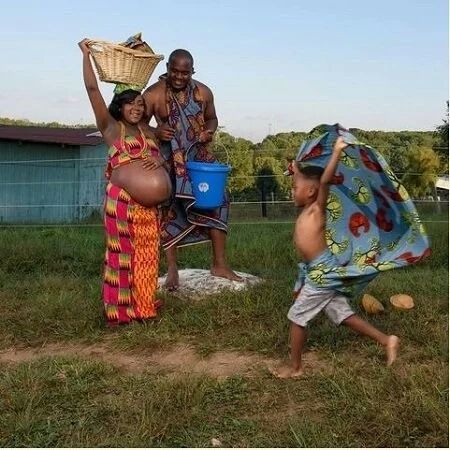
    [Picture: Nairaland]
  • Essential Attributes of HRs: (1) UNIVERSALITY

    Essential Attributes of HRs: (1) UNIVERSALITY

    Earlier this year, a young boy ran to our office crying for help. He was physically distressed and had a deep and fresh wound on the back of his head. The boy’s face and shirt were terribly stained all over by blood. He told us, his father inflicted the head-injury on him, and that it was not the first nor the second time he had suffered similar fate from his father. A team of HRCRC staff followed the boy to his parents’ home for fact-finding mission. It was discovered that his father had inflated the injury on him because of his ‘stubbornness’. When the father was found and questioned as to why he had to beat his child to that extent, he bluntly said: “na you go teach me how I de take raise my children? Na my child e be na. Ah! I can do whatever I want na. Forget tha’una human right thing. Na oyibo matter o. Here na Naija abeg”.

    Like the father of the boy referred to above, many believe that the entirety or some aspects of human rights (HRs) claims are not applicable to some persons (sometimes, because of the location, race, gender, culture, religion, profession, and other accidental attributes of such persons). Others (especially in Africa) even hold it that the notion of HRs is alien to them. To these persons, gender equality, social equity, child rights, fair wage, and other issues on the fore front of international struggles to improve human conditions are simply noises from individuals who are probably seeking attention and sympathy.

    The assumptions alluded to above are misconceived, and it is what #KnowYourRights post this week wants to address. Rights due to A because A is a human person should not be denied to B if B is a human person. This is simple logic, and it is the basis of the universality of rights. If you were to find “the lowest common factor” between a child living in America, an adult woman in Asia, and an adult man in Africa, you cannot avoid the conclusion that they are all human beings. Our common humanity demands that we all share in equal dignity. Hence, the forms in which our humanity manifest (that we are black, male, female, pastor, son, wife, physically challenged, from the east or west, a Christian or Muslim, etc) is inconsequential to the obligation we all owe each other. It is that we are to respect human dignity wherever the human being exists.

    If you consider the foregoing and relate it to our story, the boy’s father cannot absolve himself from gross failure to treat his child with human dignity by subjecting the latter to torture. His being a Nigerian (as if Nigerian laws permit that parents can do anything to their children) is immaterial to the demand of fairness in this case. In fact, Child Rights Act (2003), a federal instrument of law which has been domesticated in many states of Nigeria (including Ebonyi) expressly criminalises torture and other maltreatment of children. Also note that the law does not care whether such children are yours biologically or by other means (including acquisition for help or fostering).

    In the case of care for children, the wise sayings of Nelson Mandela, the first democratically elected President of South Africa, is apt for consideration. Mandela once said: “We owe our CHILDREN the most vulnerable citizens in any society – a life free from VIOLENCE AND FEAR.” Whether a child is in Umuezekeoha in Ezza North LGA of Ebonyi State, or in New York City, the child deserves special care for the reason that (1) their dignity is the same, and (2), “Children [everywhere] are our most valuable resource” (Herbert Hoover).

    To conclude thus, it should be noted that HRs are not some discretionary privileges that may be enjoyed by some and not all human beings (take home point for this week’s #KnowYourRights post). To drive home the strength of this assertion, Barbara de Mori (2002) succinctly puts it that HRs exist “independently of recognition or implementation in the customs or legal systems of particular countries”. In other words, the universality of HRS is such that cultural or other idiosyncratic claims about certain HRs tenets does not hold in reference to claims concerning HRs values.

    Contributors: C. O. Ikegbunam Esq.
    C. A. Nwankwo Esq.
    D. A. Okoliko

    The young boy with his wounded head

    Disclaimer:
    This is a free educational material and not a source of legal advice. If you need any, please consult your lawyer.

  • Essential Attributes of HRs: (2) INALIENABILITY

    Essential Attributes of HRs: (2) INALIENABILITY

    Inalienability of human rights. What does this mean? Don’t mind the weirdness of the sound of the word ‘inalienability’. The meaning is not as difficult as it sounds. But to help you understand, we ask you to pay attention to our story about Adaobi.

    Adaobi, a 15 years old girl is an orphan. She had lost both of her parents to a ghastly motor accident when she was barely 3. Adaobi survived the accident with her left eyes badly damaged. From that early childhood, she had known handful of suffering as none among her relatives cared to take her up. After spending much of her little but miserable years with her grandma, a young couple finally came up requesting that Adaobi should be allowed to follow them to the city. With a quick exchange of small notes between them and grannie, Adaobi was transferred to Abakaliki where she now live under a ‘mistress’. While still away in the village with granie, Adaobi had dreamt of going back to school, of pursing life goals (she had once whispered to her mother, a practicing nurse at the time Adaobi’s mother was alive, that she would like to be a doctor). Now, Adaobi is counting her 5th year in the busy city of Abakaliki. Since her arrival in the city, all she had come to learn is how retched and cursed her life is, and how lucky she was to be picked from that poor state of her little village to come and live in a city. She is uncultured, and hence, had to receive regular beatings and heavy wipes of cords from her Madam, Mrs Clara. From the rising of the sun until it later goes to rest, Adaobi is forced to do house chores. Over time, she shrinked in size and her skins were beginning to wrinkle from days of suffering and beating.

    Next to Madam Clara’s flat is Eze, a young man of about 30 years old. He had barely been around the compound beyond 3 months but had come to observe the terrible conditions Adaobi live in every day. He summoned up courage one day and approached Madam Clara, inquiring of her why she treats Adaobi the way she does. Madam Clara flared up! “How dare you question how I treat my girl. Do you know what it cost me and my husband to bring her out of that her wretched and poverty-stricken village? Adaobi is not a regular girl that deserve pampering oh. In fact, she is a witch. Do you know that if you don’t deal with this wicked girl, she wouldn’t help to lift even a grain up?

    ———————————————————–

    How many Adaobis do we have in our communities? They are people who are subjected to less humane conditions because of some unfavourable circumstances that surround their lives. Those who maltreat them and deny them basic enjoyments of life justify their actions on reasons of power relations between them and their victims. It is as if to say, some persons enjoy good things of life because they have the bargaining power to do so. They have the voice, the influence, and the might to attract privileges for themselves. For those who do not have these forces, they are on the disadvantage. They can be trampled on and treated as much as it pleases the strong.

    This is a gross understanding of one of the central principles of fairness (justice). Human rights are not up for bargains. The good life Adaobi ought to enjoy are not what she has to be in a position of power relative to Madam Clara before she can enjoy them. Her circumstances (death of her parents, her physical conditions, her vulnerability in terms of her economic background) have not taken away her dignity and the rights she possesses, such that Madam Clara can then treat her as if she is an ‘alien’.

    Talking about ‘alien’, the word came to use in 14th century as meaning “belonging to another” (merriam-webster.com). By 1600s, the word gave rise to another called ‘alienable’, an adjective describing something you could give away or transfer ownership of. ‘Unalienable’ is its opposite. By 1645 ‘inalienable’ gained currency as a synonym of ‘unalienable’, and today, it is the more common variant.

    From this little history, it is not difficult to understand why Legal Dictionary defines inalienable as that which “cannot be bought, sold, or transferred from one individual to another”, and en.oxforddictionaries.com says inalienable means it is “not subject to being taken away from or given away by the possessor”.

    Following from this, human rights such as rights to life, liberty, freedom of speech, and child rights such as rights to survival and development, access to universal basic education (see Child Rights Acts, 2003) are not negotiable on the basis of any discrimination. This should be our take home point. Adaobi, and her likes are not some aliens deserving subhuman treatment. If you have them in your care, rearrange your prejudices and begin to show them respect before the long arms of justice get you.

    Shalom!

    Contributors: C. O. Ikegbunam Esq.
    C. A. Nwankwo Esq.
    D. A. Okoliko

    Disclaimer:
    This is a free educational material and not a source of legal advice. If you need any, please consult your lawyer.

  • Essential Attributes of HRs: (3) INDIVISIBILITY & INTERDEPENDENCY

    Essential Attributes of HRs: (3) INDIVISIBILITY & INTERDEPENDENCY

    Kabiru works as a security officer in the house of Dr Alabi. Although, he was hired as a ‘gateman’, there is hardly any other chores Kabiru does not do in Dr Alabi’s compound. He washes the cars (Alabi has two, Lexus Jeep and a Toyota 4Runer), does gardening and man the security post. Since he took up the job about 3 years ago, he has not had time to go anywhere. Some time last year, he indicated interest to travel home for the Salah break, but Alabi would not have it, arguing that he did not hire him to be away from his duty post. Kabiru has since shelved the idea of traveling.

    What worries Kabiru about his job the most however, is not even the manner in which his movement is restricted. It is rather that his condition of work has been poor and unappealing. The security room where he is supposed to live and operates from has barely anything for comfort. The room has an old stool Kabiru had patched more than five times since he resumed work, and a matt he uses to pray and also sleep upon. The room’s window is like a pigeon hole so that staying inside is pretty much like being carried in a black Maria van.

    To make matters worse, Dr Alabi has not been forthcoming with Kabiru’s N10,000 monthly pay as at when due. For about 7 months now, he has been fed one story or another as to why he should exercise patience. While Kabiru waits in patience however, Dr Alabi never misses to entertain ‘business friends’, family members and ‘associates’ to sumptuous parties and dinners at almost every turn of the weekend. It is during this type of occasion that Kabiru gets to ‘feel his Oga’. He would be served food enough to keep his mouth munching for days. And when latter he gets to request for his meagre salary, he would be told:

    “Ah, Kabiru! Don’t act like we treat you bad in this house? We give you food here. Wait, in this era of economic recession, who doesn’t owe salary in this country? Abeg, wait till next week please.”
    _____________________________________________

    Kabiru’s fate is similar to many people in our society today. Ours is a society that cuts and separate what are individuals’ due, and then give them in piecemeal while framing it to look as if, they are actually doing the individuals really some good that deserve commendation. For instance, during the peak of late payment of salary in Nigeria, the one blamed on the recent economic recession, few governments who were managing to keep up to date were busy broadcasting on air how good and praiseworthy their principals were. They do not owe salaries. But after a check on these governments, it was discovered that these same governments owe huge backlog of emoluments due to their workers outside the statutory monthly take home, including refusal to honour promotion awarded to workers. Till date, some states are still paying piecemeal salaries, with some workers receiving almost 25% of their monthly pay.

    Away from salary, dignity of labour requires that a person’s condition of work should be dignifying. This principle takes into cognisance, things like number of hours spent on work, hours given for rest and leisure, and the condition of work space, whether such supports the worker to deliver more efficiently. It also involves whether a worker has access to health package that allow him/her to enjoy good health benefits. Opportunity for workers to development their capacity, and for what is called “vertical mobility of labour” (i.e. room for promotion) also count in favour of dignifying work condition. These issues are well covered in international instruments like International Covenant on Economic, Social and Cultural Rights, (see Article 7, a through d). Section (d) of Article 7 particularly addresses the need for leisure, “periodic holidays with pay, as well as remuneration for public holidays”.

    Although, Nigeria is a signatory to the above Covenant, both public and private employers of labour continue to selectively honour some while violating many of these rights. their argument is akin to Dr Alabi’s family. They can afford to owe workers, but not the other way around. At least, they fulfil ‘some obligations’. Unfortunately, one of the fundamental principles undergirding respect for human rights is indivisibility. Human rights are a wholesome set of fair packages which should not be selectively respected.

    Why is this the case? Well, no right is more important than the other, and each right is intricately linked to the rest of others. Take for instance, the picture painted above about Kabiru and his job. You cannot begin to discuss whether his pay is more important than the condition of his work. In each category, the condition of where he works, the amount of rest he gets, and of course, his take home package, all of these things invariably affect his human dignity by adding something to it (when they are fairly supplied) or subtracting something from it (when they are not met).

    Are rights interdependent then? Absolutely, yes. The health of a worker obviously affects his/her productivity and job satisfaction. Equally, capacity building can positively impact on the dignity of labour. Hence, neglecting these elements, as many employers are doing in our society, grossly negate best practice and of course, violates human rights principles.

    Beyond labour, this discussion can be applied to other sectors of the society. For instance, you don’t choose to feed your children while refusing them access to education when you can afford, or you don’t praise yourself for giving food money to your wife everyday while at every slight provocation, turn her into a punching bag, or you don’t choose to seek citizens’ votes while refusing them participation in issues of governance. Human rights are indivisible and are interdependent.

    Shalom!

    Contributors: C. O. Ikegbunam Esq.
    C. A. Nwankwo Esq.
    D. A. Okoliko

    Disclaimer:
    This is a free educational material and not a source of legal advice. If you need any, please consult your lawyer.

    HRCRC Staff having outdoor activity during their 2017 Staff Day
  • Is child rights protected by law?

    Is child rights protected by law?

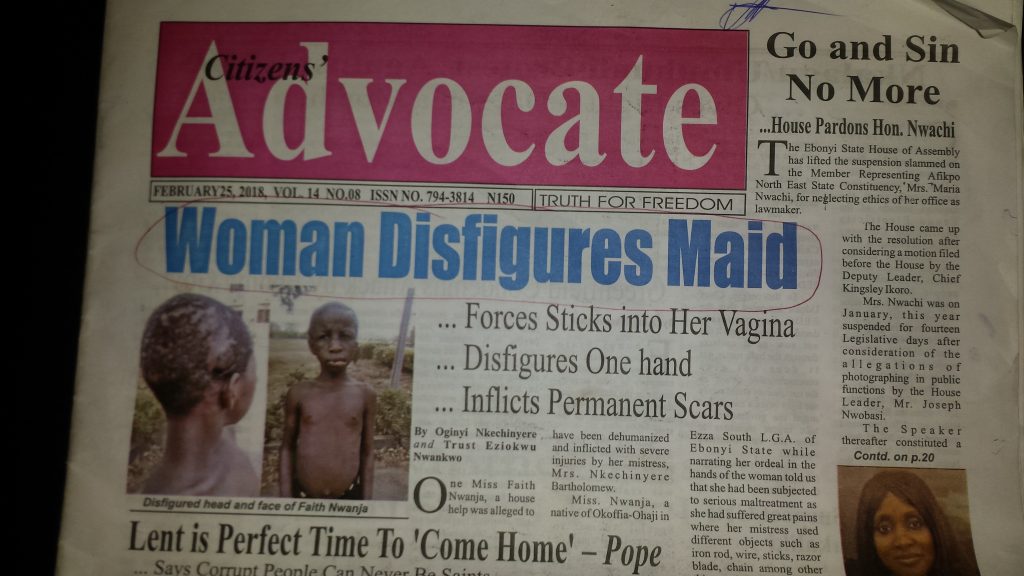
    Recently a story about a 4-year-old girl, Uloma, made a headline in a regional newspaper, Citizens’ Advocate. Uloma was found in a slave-like manner under the watch of a certain woman, Mrs Nwali Josephine. The woman is not the little girl’s mother. Weeks before Uloma was discovered, she hawked for her ‘madam’, Mrs Nwali, with little care and feed. Her suffering was terrible such that when the Ministry of Women Affairs and Social Development found her, she was ill and had pultruding stomach indicating poor care and feeding.

    You might be wondering how Uloma ended up with Mrs Nwali? Well, her mother, Veronica Igwe traded with Mrs Nwali at a rice-mill and could not pay up a balance of N 100. Uloma was then exchanged in place of the debt pending when her mother could pay. Now in the police custody over alleged child trafficking, Mrs Nwali and Mrs Igwe are wondering why anyone should frown at their actions. Was Uloma not freely given by her mother, and didn’t Mrs Nwali promise to return the child whenever she gets her pay back?

    It is not difficult to see the error in the above reasoning. While the two adults engage each other in a contractual agreement, the involvement of the child problematizes their action. Child rights is a fundamental issue worldwide, and both Nigeria’s laws and international instruments have special provision for child rights protection. Often times however, interest of the child is rarely or never factored whenever adults take decisions that involve a child as it happened in Uloma’s case. The fact that children everywhere are generally dependent heightens their vulnerability. It is precisely for this reason however, that the UN Conventions on the Rights of the Child (CRC) {28/11/1989} sets out principles to mainstream child interest, such that in all nations of the world, for every act which may impact on a child, the interest of that child takes precedence. The African Charter on the Rights and Welfare of the Child, adopted at the General Assembly of AU in 1990 also prioritises child’s interest, insisting the child has the right to grow up in the family environment free from violence, fear and torture.

    To step it down, beyond the provisions of the Nigeria’s Constitution in Chapter IV which sets out fundamental rights, and which in principle, are extensive to children, recent effort to give special consideration to the spate of child rights violation in Nigeria has seen the UN’s CRC domesticated as Child Rights Acts in 2003. Many states have keyed into the federal Act by enacting laws to that effect including Lagos, Ebonyi (in 2010), Enugu (in 2016) and 21 others (living 12 more states behind).

    Despite this effort however, more Nigerian child are exposed to violence and abuse ranging from physical to psychological and sexual. The fact that recent survey (2014) by the National Population Commission (supported by UNICEF and the US Centres for Disease Control and Prevention) indicates that 6 out of 10 children experience at least one form of violence before their 18th birthday should make us all to shudder and awaken in us a sense of urgency to campaign aggressively against child rights violations in our society. Nelson Mandela made a remark that has import for this call. He once said:

    “Safety and security don’t just happen, they are the result of collective consensus and public investment. We owe our CHILDREN the most vulnerable citizens in any society – a life FREE from VIOLENCE and FEAR”. It is up to you and us to ensure we don’t have more Uloma situations in our communities.

    When it comes to human rights, we must not forget that existence of a law giving express protection to them is not the only ground to ensure their respect. This point has been made in a Journal of Jurisprudence (2010), vol. 1, by Gumbis, J. et al. who argues that “the fact that a person has rights has nothing to do with enacting these rights in legal document”. It is rather embedded in the natural principle upholding human dignity. Thus, legal lacuna can never justify actions negating human dignity in any clime.

    Shalom!

    Contributors: C. O. Ikegbunam Esq.
    C. A. Nwankwo Esq.
    D. A. Okoliko
     

    Disclaimer:
    This is a free educational material and not a source of legal advice. If you need any, please consult your lawyer.

    A snapshot from Citizens’ Advocate newspaper