
Is child rights protected by law?

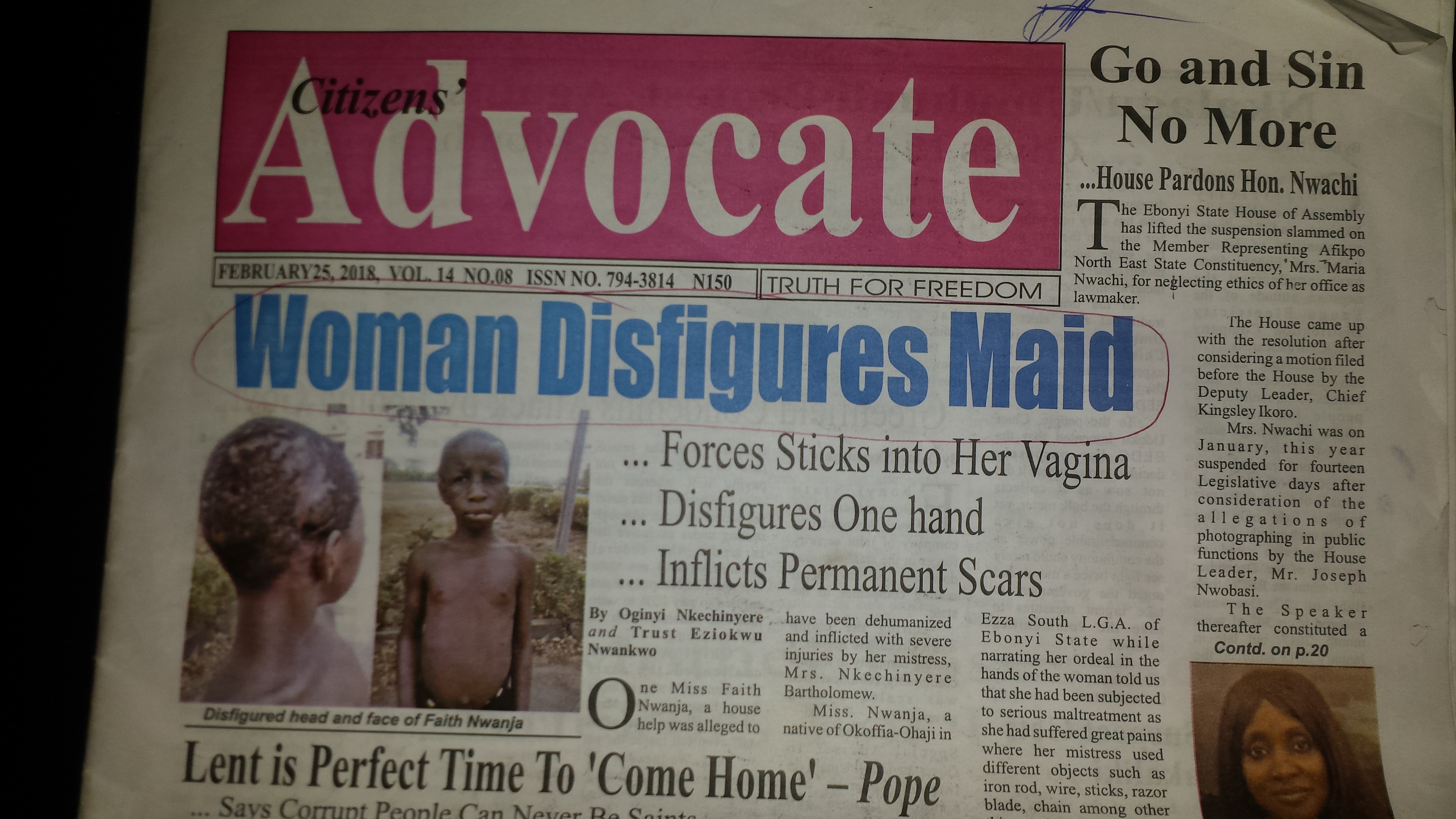
Recently a story about a 4-year-old girl, Uloma, made a headline in a regional newspaper, Citizens’ Advocate. Uloma was found in a slave-like manner under the watch of a certain woman, Mrs Nwali Josephine. The woman is not the little girl’s mother. Weeks before Uloma was discovered, she hawked for her ‘madam’, Mrs Nwali, with little care and feed. Her suffering was terrible such that when the Ministry of Women Affairs and Social Development found her, she was ill and had pultruding stomach indicating poor care and feeding.

You might be wondering how Uloma ended up with Mrs Nwali? Well, her mother, Veronica Igwe traded with Mrs Nwali at a rice-mill and could not pay up a balance of N 100. Uloma was then exchanged in place of the debt pending when her mother could pay. Now in the police custody over alleged child trafficking, Mrs Nwali and Mrs Igwe are wondering why anyone should frown at their actions. Was Uloma not freely given by her mother, and didn’t Mrs Nwali promise to return the child whenever she gets her pay back?

It is not difficult to see the error in the above reasoning. While the two adults engage each other in a contractual agreement, the involvement of the child problematizes their action. Child rights is a fundamental issue worldwide, and both Nigeria’s laws and international instruments have special provision for child rights protection. Often times however, interest of the child is rarely or never factored whenever adults take decisions that involve a child as it happened in Uloma’s case. The fact that children everywhere are generally dependent heightens their vulnerability. It is precisely for this reason however, that the UN Conventions on the Rights of the Child (CRC) {28/11/1989} sets out principles to mainstream child interest, such that in all nations of the world, for every act which may impact on a child, the interest of that child takes precedence. The African Charter on the Rights and Welfare of the Child, adopted at the General Assembly of AU in 1990 also prioritises child’s interest, insisting the child has the right to grow up in the family environment free from violence, fear and torture.

To step it down, beyond the provisions of the Nigeria’s Constitution in Chapter IV which sets out fundamental rights, and which in principle, are extensive to children, recent effort to give special consideration to the spate of child rights violation in Nigeria has seen the UN’s CRC domesticated as Child Rights Acts in 2003. Many states have keyed into the federal Act by enacting laws to that effect including Lagos, Ebonyi (in 2010), Enugu (in 2016) and 21 others (living 12 more states behind).

Despite this effort however, more Nigerian child are exposed to violence and abuse ranging from physical to psychological and sexual. The fact that recent survey (2014) by the National Population Commission (supported by UNICEF and the US Centres for Disease Control and Prevention) indicates that 6 out of 10 children experience at least one form of violence before their 18th birthday should make us all to shudder and awaken in us a sense of urgency to campaign aggressively against child rights violations in our society. Nelson Mandela made a remark that has import for this call. He once said:

“Safety and security don’t just happen, they are the result of collective consensus and public investment. We owe our CHILDREN the most vulnerable citizens in any society – a life FREE from VIOLENCE and FEAR”. It is up to you and us to ensure we don’t have more Uloma situations in our communities.

When it comes to human rights, we must not forget that existence of a law giving express protection to them is not the only ground to ensure their respect. This point has been made in a Journal of Jurisprudence (2010), vol. 1, by Gumbis, J. et al. who argues that “the fact that a person has rights has nothing to do with enacting these rights in legal document”. It is rather embedded in the natural principle upholding human dignity. Thus, legal lacuna can never justify actions negating human dignity in any clime.

Shalom!

Contributors: C. O. Ikegbunam Esq.
C. A. Nwankwo Esq.
D. A. Okoliko


Disclaimer:
This is a free educational material and not a source of legal advice. If you need any, please consult your lawyer.
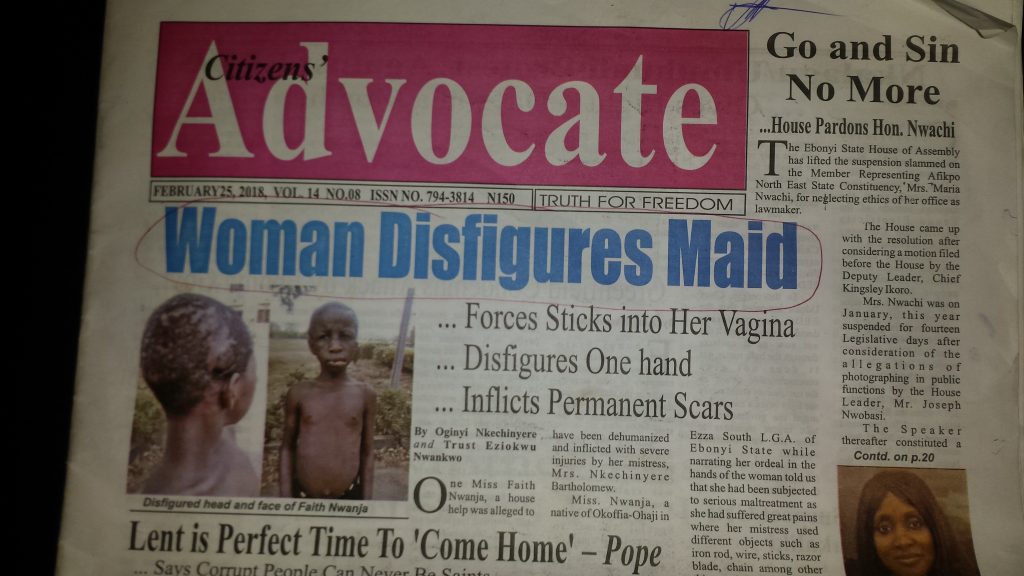
A snapshot from Citizens’ Advocate newspaper


DOES OUR CONSTITUTION PROVIDE FOR THE PROTECTION OF HUMAN RIGHTS?

Oluchi was on his way to a lecture that morning. About three boys accosted him and ordered that he stopped. He turned towards them and greeted.

“O boy e, see this boy oh! Na so them dey greet senior men?”, one of the boys demanded.

Oluchi looked confused, wondering what the fuss was about. Before he could say something, one of the boys, who had gone behind him, hit him hard “packing his feet off the g

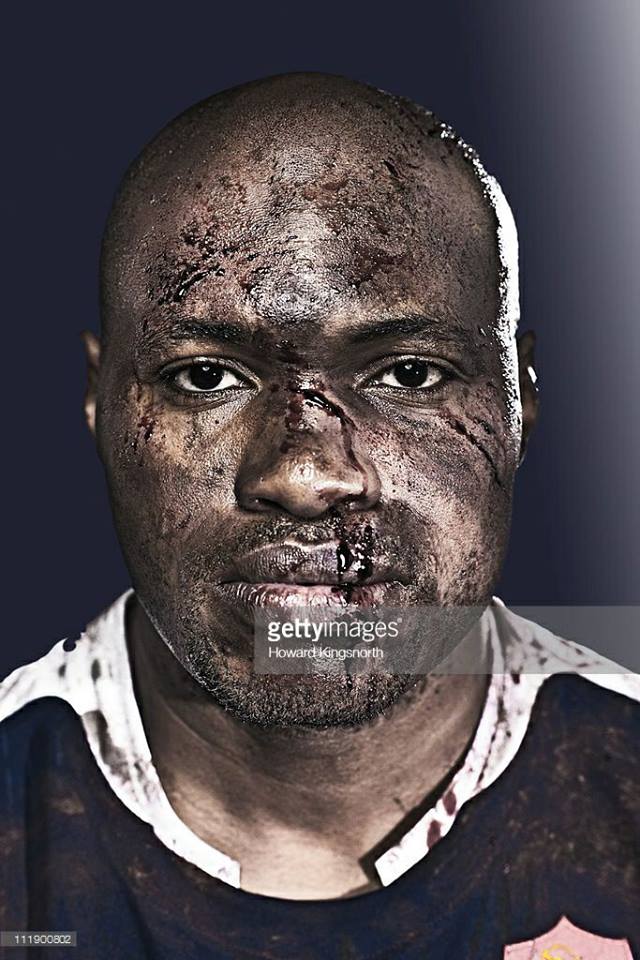
Source, gettyimages

round”. Oluchi fell with the face downward. Others joined in the beating, pounding him hard until he was left bruised and exhausted.

Chinyere was on that route to school that morning too. From a distance, she observed unusual movements of fists but couldnt not make much of her perception. As she drew near however, she saw that three guys were running away from what looked like a human figure lying on the ground. She got to the spot and found a man physically battered. She helped the man up and assisted him to a nearby clinic for medical help. She then inquired from him if he knew his attackers and what led to it. Upon realising the injustice done to him, she suggested to the man to report the matter to the police for redress.

Ah, those cult boys! Nothing would happen to them oh. Law dey wey dey protect person for this country? Oluchi voiced his frustration.
________________________________________

From the above narrative, we might consider that Oluchis expression in the preceding paragraph tells of faithlessness in the power of the Nigeria legal system to protect individuals in Nigeria. If we take it to be so, we might go further to outline factors that create such hopelessness in our justice system, like police indifference to treating citizens complaints, nepotism, godfatherism, inadequate manpower and corruption in the justice sector. These things which constitute clogs in the wheel of justice can wane citizens hope to access justice in any society.

Beyond this however, the story equally points us to wonder if our law(s) provides for the protection of Fundamental Human Rights (FHRs) as espoused in the UN Universal Declaration of Rights to which Nigeria is a signatory. The answer to that is in the affirmative. The 1999 Constitution of the Federal Republic of Nigeria (as amended) expressly considers FHRs in Chapter IV. Lets pick on the key points.

Right to life
Right to dignity of human person
Right to personal liberty
Right to fair hearing
Right to private and family life
Right to freedom of thought, conscience and religion
Right to freedom of expression and the press
Right to peaceful assembly and association
Right to freedom of movement
Right to freedom from discrimination on the grounds of ethnic group, place of origin, circumstance of birth, sex, religion or political opinion.
Right to compensation for property compulsorily acquired

These are rights naturally accruable to every person by virtue of his/her existence as a human being and the provision of the constitution is that where such is violated, redress can be sought. With regard to Oluchi, he can appeal to section 34 of the Constitution which covers right to dignity of human persons to seek justice. Precisely, section 34 sub 2A grants that no person shall be subject to torture or to inhuman or degrading treatment”. The Constitution reposes in the court the authority to entertain allegations bothering on violations of FHRs such as the one cited above.

There are other human rights which, though not justiceable (cannot be enforced), are in the Constitution as expressions of aspiration for Nigerians. They include:

Free and compulsory education
Adequate health care, gainful employment
Shelter, food, etc
This set of rights, found in Fundamental Objectives and Directive Principles of State Policy under Chapter II of the Constitution, are aspirations attainable if and when the State has the resources. However, we believe the two sets of rights are both fundamental and complementary. To understand this, consider the implication of life without gainful employment or food to sustain life in the first place. It is the reason why International Bills of rights have argued that Human Rights are interdependent, interrelated, indivisible and universal. Hence, there is a need for our legal framework to consider upgrading Economic, Social and Cultural rights to fundamental rights.

Shalom!

Contributors: C. O. Ikegbunam Esq.
C. A. Nwankwo Esq.
D. A. Okoliko


Disclaimer:
This is a free educational material and not a source of legal advice. If you need any, please consult your lawyer.

RIGHT TO FAIR HEARING

As Ngozi descended the stairs into the mall hall at the first floor, she just knew she hadn’t been treated right. Tears welled up in her eyes and her knees were still trembling. How come she was not given a chance to defend herself? Each time she attempted to speak before her supervisor and the HR, they shouted her down.

Earlier in the morning, at about 8.00 hours, she was at her post as a cashier in a popular and busy mall. She had resumed at about 7.20 which was 10 minutes away from the red time of 7.30. As she was dressing her stands and fixing up the machine to get ready for the day’s job, Mr. Anale called up to her, instructing that she go see the top boss upstairs. It was at the boss’s office she was handed a note that spelled she was no longer needed at her place of work.

Before being given the letter, the boss had told her the management got a report on her that she fought a customer on her way home the previous day. According to them, the said customer had raised some issues concerning a transaction Ngozi handled for her during the day and instead of showing ‘a good customer relationship’, Ngozi engaged her in a public fight.

“That is unacceptable from any of our staff. You’re hereby fired”.
______________________________________________

The story above presents us an interesting scenario that is very much related to article 10 of UN Universal Declaration of Human Rights. The article provides for rights to “fair and public hearing”and is enshrined in the Nigerian Constitution under Chapter 4, section 36. Ngozi case is chosen because it mirrors what often happens at homes, public instructions (e.g. church, schools, and hospitals) and private institutions when people are summarily judged of having committed offense. Whenever people are condemned without an opportunity to present their defense, they are left grieved. Fundamentally, such incident negates natural justice which provides that anyone accused should have,Fair hearing,that is, such an individual is given an opportunity to present evidence to support this or her case and to discover what evidence exists against him or her. Fair hearing must not be only in a criminal or civil trial as in a court. It also applies to administrative procedures to entertain complaint as provided for in section 36, subsection 1 of the Nigerian Constitution (1999 as amended):

“In the determination of his civil rights and obligations, including any question or determination by or against any government or authority, a person shall be entitled to a FAIR HEARING within a reasonable time by a court or other tribunal established by law and constituted in such manner as to secure its independence and impartiality”.

Criminal case deserves special attention as often times, extra-judicial killings/corporal punishment take place in many communities within our country. African Commission on Human and People’s Rights (ACHPR) provides Principles and Guidelines on the Right to a Fair Trial and Legal Assistance in Africa (2003). A(1) provides in clear terms that “in the determination of any criminal charge against a person, or of a person’s rights and obligations, everyone shall be entitled to a fair and public hearing by a legally constituted competent, independent and impartial judicial body”. In other words, it is not in the place of a mob or group of persons other than CONSTITUTED authorities to hear, convict and met out punishment to anyone SUSPECTED to have committed a crime or an offence. And section 36(4) of the Nigerian Constitution grants that “whenever any person is charged with a criminal offence, he shall, unless the charge is withdrawn, be entitled to a FAIR HEARING in public within a reasonable time by a COURT or TRIBUNAL”. Under these instruments, ‘jungle justice’ or mob killing/punishment is criminalised. This is because, in whatever form they come, summary judgement takes away element of justice, fair hearing, by which an accused is supposed to have a chance for reasonable defence. In the case of ‘jungle justice’, section 36(5) of the Nigerian Constitution which provides that a suspect of any crime is presumed innocent until proven guilty is blatantly violated. Note that where the accused is to be ‘proven guilty’ is not at the market square, the police post or at the field. It is at a hearing that is constituted by “competent, independent and impartial judicial body” (e.g., the court, tribunal or administrative authority vested to entertain specific complaint).

Back to Ngozi, what can she do given the circumstances surrounding her dismal from job? If the company where she was fired from has higher authority than that which effected her dismal, she can appeal to it for redress. Another option is to institute legal action in the interest of her fundamental rights. Caution however, is needed. The action needs to take into cognisance terms of engagement between the employer and Ngpzi, and Nigeria Labour Laws. Michael Dugeri, a Regulatory Compliance and Commercial Law Advisor, offers insights on the difference between termination of a contract of employment and a dismissal under Nigeria’s legal system. According to him, “In Nigeria, an employer can terminate the contract of employment with his worker at any time and for any reason or for no reason at all provided that the terms of the contract of service between them are complied with”. See Olaniyan v. University of Lagos (1985) 2 NWLR (Pt. 9) 599 – 685 and Opuo v. NNPC (2001) 14 NWLR (Pt. 734) 552. With dismissal however, the employer is required to give reason for the action. See Union Bank of Nigeria Plc v. Soares (2012) 11 NWLR (Pt. 3112) 550.

Our take is that whether termination or dismissal, there are procedures (could be internal or external, e.g. labour laws), and the principle of fair hearing is central to the integrity of that procedure. Ramatu Umar-Bako (2012) cited a case which highlights this point:

“On 20 May 2011, a Federal High Court sitting in lagos, nullified the dismissal of the former Director – General of the Nigerian Stock Exchange (NSE), Professor Ndi Okereke – Onyuike and awarded her N500 million naira in damages for exemplary and aggravated damages for recklessness. It held that Okereke – Onyuike’s RIGHT TO FAIR HEARING was breached, the letters removing her were reckless, hasty and done in bad faith. The Judge maintained that it was ridiculous for the NSE to remove her within 24 hours based on bad and unverified allegations’ and that the NSE did not comply with the condition precedent in removing the plaintiff.”

This landmark judgement should serve to encourage other employees who have been unfairly dismissed like Ngozi in Nigeria. Equally, organisations can learn from it to avoid facing legal actions by ensuring employees are fairly treated before dismissal.

For a detailed account of principles and guidelines on fair trial, see ACHPR’s Principles and Guidelines on the Right to a Fair Trial and Legal Assistance in Africa (2003).

Shalom!

Contributors: C. O. IkegbunamEsq.
C. A. Nwankwo Esq.
D. A. Okoliko

{image, defendernetwork.com}


Disclaimer:
This is a free educational material and not a source of legal advice. If you need any, please consult your lawyer.

Rights of the Suspect and Accused

Recently, a young man came to our office alongside his old father. They came to lodge a complaint. About a month earlier, they said, they got a call from an unidentified female informing them that their son was picked up by the DSS from one of the streets in Abakaliki. They quickly got to town and went to inquire at the DSS state’s command and were denied acc

DSS men

ess to the facilities. They requested to know whether their son was being held at the facility and on what ground he was held. Their request was ignored, and they were asked to leave the premises. At another time, they contracted a lawyer whom they took there for intervention, we were told. The lawyer was equally turned away without seeing the detainee except that, he was told, the boy was in their custody.

It took our intervention to later find out that the boy was charged to high court for ‘kidnaping’ and was remanded in Abakaliki Prison. All the time the boy was held in their custody, he was denied access to his relatives and to legal representation.
______________________________________________

One striking feature of democracy is the rule of law. Where due process is blatantly ignored or disregarded, democracy suffers a great blow, and so does human rights. The case represented above is very common, not only with the security agency mentioned, but with many others, including the police force. It is as if, for many security agents, there are no rules guiding the procedure of arrests and detention, and that once an individual is a suspect in an offence or crime, the individual seizes to have human rights. This practice and the ideology that informs it violate international norms and practices regarding arrest, detention and trial procedures as can be found in Universal Declaration of Human Rights (UNDHR), International Convention on Civil and Political Rights (ICCPR) and Convention against Torture and Other Cruel, Inhuman or Degrading Treatment or Punishment (CAT) and Body of Principles for the Protection of All Persons under Any Form of Detention or Imprisonment. It equally negates Nigeria’s laws, including the Constitution of the Federal Republic of Nigeria (1999 as amended), Criminal Procedure Act, Criminal Procedure Code and the most recent act which merged the last two, Administration of Criminal Justice Act (ACJA, 2015). With regard to arrest and detention, there are key human rights issues that must be safeguarded as far as best international principles and practice are concerned. They include:

Right to liberty and security of person and to freedom of movement (ICCPR, 9[1], Constitution, 35[1])
Prohibition of arbitrary arrest (UDHR, 9)
Right to be informed of reasons at time of arrest and of any charges (Constitution, 36[6][a], 35[2], ACJA, 6)
Right to be brought promptly before a judge (UDHR, 10)
Right to trial within reasonable time, or release (Constitution, 36[1], ACJA)
Right to prompt access to a lawyer (Constitution, 36[6][C])
Right not to confess or testify against oneself (of silence) (ACJA, Constitution, 35[2])
Right to an interpreter when necessary (ACJA, Constitution, 36 [6][e])
Right to prompt notification of family (ACJA,
Right to presumption of innocence until proven guilty (UDHR, article 11, ICCPR 14[2], Constitution 36[5])
Right to humane treatment as a detainee (ACJA, 8)
Because of the requirement to safeguard these rights, security operatives are supposed to be guided by four principles – LEGALITY, NECESSITY, PROPORTIONALITY and ACCOUNTABILITY – whenever they carry out arrest and detention of persons suspected or accused of committing an offence/crime.

By legal consideration, they are to ascertain in the particularities of a case whether an arrest with/without a warrant is needed. It also requires the security agent to determine whether a mere invitation or arrest for detention is needed in a particular case. This is because certain civil cases do not require the involvement of police carrying out arrest. In McLaren v. Jennings, the Court of Appeal held in 2003 that it was unlawful for the police to arrest and detain the appellant with regard to the collection of a debt (a civil matter) which could be determined in courts or through the use of ADRs. Unfortunately, in practice, some security agents are often used to settle scores by individuals who consider themselves ‘connected’ to their power (soft or hard).

By necessity, issues of timing, and place of arrest are to be considered. Does it require doing it in such a manner to cause public knowledge which may cause harm to the reputation of the suspect (remember, a suspect is not a convict) or could it be done in some quite place and time.

Proportionality calls for prudency with regards to the use of force during an arrest (ACJA now provides that no unnecessary restraint such as handcuff is required).

Accountability requires that arrested persons should be brought before a court of competent authority who must decide the validity of the arrest and whether further detention is necessary or not. It also places a burden on the security agents to ensure relatives of detainees are promptly informed.

Thus, if you examine the particular case shown in the first paragraph critically, one can detect that there were serious violations of the fundamental rights of the suspect. He was denied access to a lawyer and his relatives were shut out from him. Also, if we were to go by the provision of the ACJA which now requires that detention without appearance before a judge/magistrate going beyond 48hrs at most is unnecessary, we can see how the young man’s rights to ‘be brought promptly before a judge’ was violated. Any action against the agency in question has to take these factors into consideration. More importantly, our interest here is to demonstrates to readers that even a suspect does have fundamental rights that need not be compromised.

Shalom!

Contributors: C. O. Ikegbunam Esq.
C. A. Nwankwo Esq.
D. A. Okoliko

Disclaimer:
This is a free educational material and not a source of legal advice. If you need any, please consult your lawyer.

Access to Justice Is One of Our Core Drives

By Barr. Jude Ogbunkwu

The collection of activities that is termed as Access to Justice programme at Human Rights and Conflict Resolution Centre (HRCRC) in Abakaliki constitute the foremost works that the organization do right from its inception. They include prison/police cell welfare, facilitation of Gaol delivery, pro bono legal services, and general legal services for the less privilege. At the time, the organisation was nursed in late 1980s, Fr. Kevin O’Hara (SPS), was the Parish Priest of Corpus Christi Parish Umuhuali where he witnessed an unlawful detention of one of his parishioners, one Peter Nwekeoga. In attempt to intervene to see to the release of Peter, he discovered the unspeakable and terrible state of prisoners and the prison service in the town. He immediately felt moved to do something; it was this that opened door to series of interventions targeting ameliorating the conditions of lives in the prison which became a drive for the formation of an organisation that aimed at advancing justice for all, especially the most vulnerable ones in the society.

In the different phases of the organisation, firstly Human Rights Commission (HRC), then Institute for the Enhancement of Human Dignity (I.E.D), HRC again, and then HRCRC, the organisation has kept Access to Justice as a core programme in the Centre. The programme offers free legal services to victims of Human Rights Abuses. The Centre is grateful for the support it has enjoyed from partners to carry out its functions of widening the scope of justice for the vulnerable of our community. Some of these partners who have supported us in the past include Misseror, Manos UNIDA, Cordaid, Catholic Reliefs Services, St. Patricks’ Society, Irish Aids and Misean Cara being the last sponsor of our project titled: “Enhancing the Child Rights in Ebonyi State” which lasted between 2015 and 2017.

Access to Justice department of HRCRC has helped many people who left to circumstances of odds in our nation’s justice system are greatly disadvantaged to access fairer treatment in legal struggles. HRCRC team at the department offer legal advices, prepare legal documents and interventions and represent individuals in court; that is, those who are disenfranchised by the justice system so that they can have fair hearing and have their noble rights respected. During the course of the project, “Enhancing the Rights of the Child in Ebonyi State” (lasted from Jan. 2016 to March 2017), a total of 130 persons who were unfairly detained in prisons and police cells were released through the effort of the department.

Most of the beneficiaries of our interventions are the poor who can hardly afford the high cost of accessing justice in the Nigerian context. Consider Mrs. Blessing Okechukwu for instance. She was a pregnant and nursing mother who was charged for stealing cocoa yam worth of four hundred naira (N400) from a local market in her small community. Upon her arrest, she was remanded in prison custody at the Nigerian Prison in Abakaliki alongside her little baby for six months without trial. When she was discovered during our routine checks and monitoring of prisons across the state, our legal team took up the matter before a magistrate who upon hearing struck out the case for lack of diligent prosecution of the matter by the complainant. One of the motivations for our intervention has to do with her little child who had to suffer untold hardship for no fault of his.

Inability of persons going through legal struggles to afford ‘cost of justice’ in Nigeria is a contributing factor to prison congestions in Nigeria. Justice is quite expensive in our society. You only have to consider what it takes to get records of proceedings on any case or information, to file motion for appeal or bail and the several journeys to the court of arraignment or trial that a lawyer have to make, and you may excuse legal fees that lawyers charge. This is not to speak of sharp practices by some lawyers and other elements within the justice system. Here at HRCRC, we are committed to serving the interests of justice so that more people can lead happier lives.